
Why Unskilled People Think They Are Amazing
This B2 lesson explores the Dunning-Kruger effect through an engaging TED-Ed video and self-reflection activities. Upper-intermediate students examine why incompetent people often overestimate their abilities while learning psychological vocabulary and discussing self-perception.
Lesson overview
- Explore the psychology behind self-assessment and illusory superiority
- Learn vocabulary related to competence, expertise, and cognitive bias
- Develop listening comprehension skills through an animated TED-Ed video
- Discuss strategies for accurate self-evaluation and seeking feedback
| Level | Vocabulary | Video Length | Lesson Time |
| B2 / Upper-Intermediate | 10 words | 5:07 min | 60 min |
Vocabulary
- competent
- incompetent
- stack up against
- superiority
- overrate
- delusion
- expertise
- deficit
- inept
- self-perception
Contents
- Lead-in
- Vocabulary preview
- Vocabulary
- Video
- Questions
- Quote
- Practice
- Speaking
- Discussion
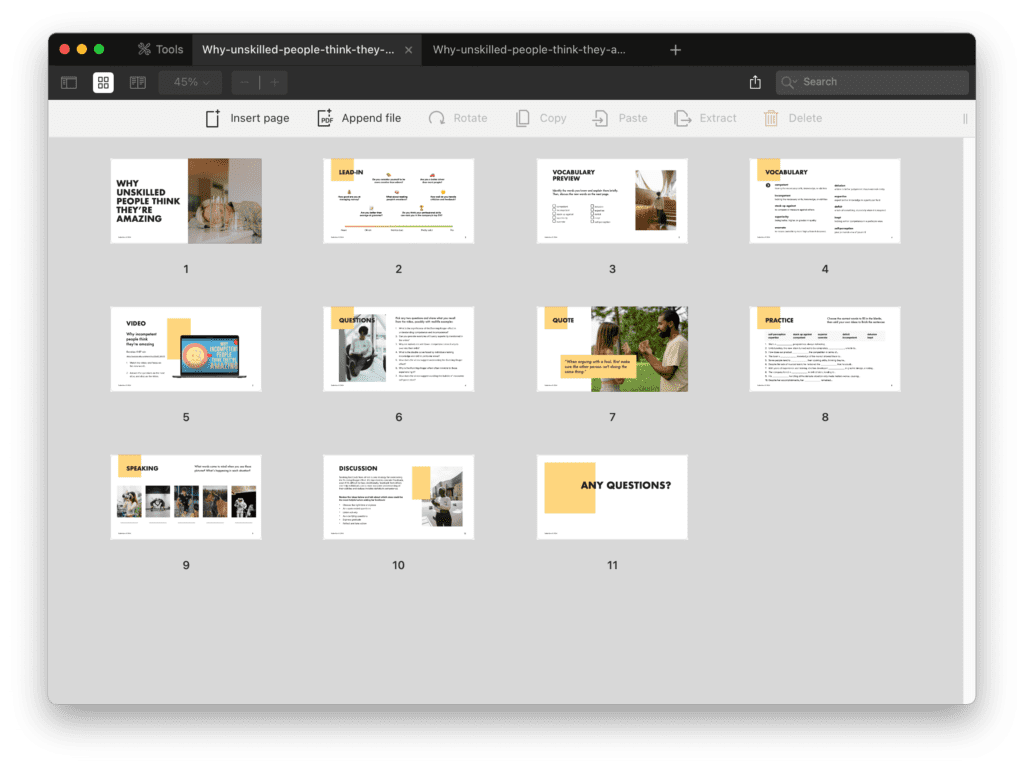
Begin with the lead-in activity on page 2 where students rate themselves across different skills. Students mark where they fall on the scale from “noob” to “pro” for things like driving, grammar, and managing money. Most people will rate themselves above average, which is exactly the point. After they’ve marked their answers, ask how many rated themselves as “pretty solid” or “pro” in at least one area. This shows the overconfidence tendency the lesson is built around.
Pre-teach the vocabulary on pages 3-4 before the video. Have students identify words they already know and explain them to partners, then go through the definitions together. These ten terms (competent, incompetent, stack up against, superiority, overrate, delusion, expertise, deficit, inept, self-perception) come up throughout the TED-Ed video, so students need them beforehand.
The video on page 5 runs just over five minutes. It explains the Dunning-Kruger effect through animation and examples. Play it twice. First viewing is for general understanding. Second viewing is for note-taking on the questions from page 6. Those questions ask students to recall things like illusory superiority, the double curse of incompetence, and how to overcome inaccurate self-perception.
After the video, move to the comprehension questions on page 6. Students pick two questions to answer, which keeps things manageable while making sure everyone engages. Push them to connect the concepts to real situations they’ve seen or been through. The quote on page 7 offers a counterpoint to the Dunning-Kruger idea and usually sparks good discussion about when confidence helps versus when it misleads.
The practice exercise on page 8 uses sentence completion. Students choose the right word then finish each sentence with their own ideas. This moves past simple gap-fills into something more creative. The speaking activity on page 9 uses images to prompt discussion about competence in different fields. Students describe what they see and tie it back to the lesson’s themes.
Close with the discussion on page 10 about seeking feedback. The six strategies listed give concrete steps for overcoming self-assessment bias. Have students rank which strategies they find most useful or hardest to actually do.
