
Useful Everyday Phrases

This pre-intermediate lesson teaches essential everyday phrases for natural English conversation. Students practice common greetings, polite expressions, and conversational responses through interactive activities. The A2-level material helps learners sound more natural and confident in daily social interactions with English speakers.
Lesson overview
- Practice common greetings and time-appropriate expressions for different situations
- Learn polite phrases for everyday interactions like apologizing and saying goodbye
- Develop conversational skills by asking and responding to social questions
- Apply everyday phrases through role-play dialogues and written conversations
| Level | Vocabulary | Lesson Time |
| A2 / Pre-Intermediate | 15 phrases | 60 min |
Vocabulary
- Hi there!
- Excuse me.
- Good luck!
- No problem!
- Take your time.
- That’s a good point.
- Don’t worry about it.
- I’ll be there in a minute.
- I don’t get it.
- See ya later!
- Bless you!
- Congratulations! Congrats!
- Cheers!
- Get well soon!
- Sorry, my bad!
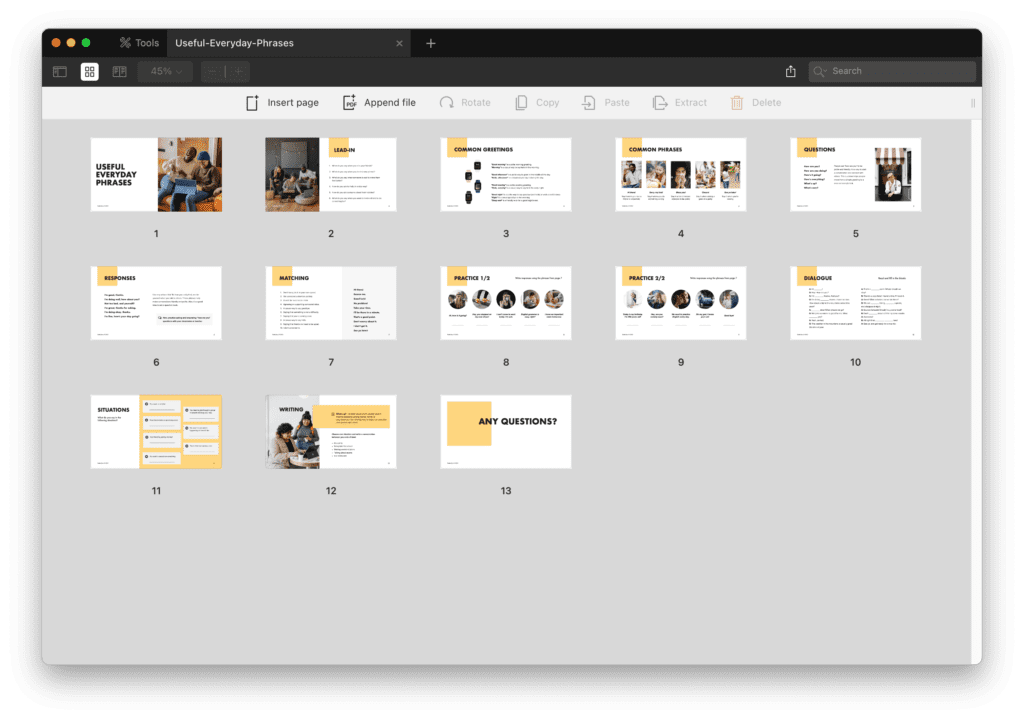
Contents
- Lead-in
- Common greetings
- Common phrases
- Questions
- Responses
- Matching
- Practice 1
- Practice 2
- Dialogue
- Situations
- Writing
Start with the lead-in questions on page 2 to see what students already say in different situations. Many rely heavily on textbook phrases, so this lesson helps them sound more natural. Review the greetings on page 3, focusing on the difference between formal and casual versions. Students tend to overuse formal greetings, so point out when casual ones fit better.
The common phrases on page 4 work as a quick visual review. Have students repeat each phrase with the right intonation since tone matters a lot with expressions like “my bad” and “see ya later.” Page 5 introduces different ways to ask “how are you,” which confuses learners who think there’s only one correct version. Explain that these questions all mean basically the same thing. Practice the responses on page 6 and make sure students know they should ask something back to keep the conversation going.
The matching activity on page 7 checks understanding of the 10 key phrases from the lesson. Students apply them in the practice activities on pages 8-9, writing responses to different situations. Lower-level students might need more help here, so consider doing the first few examples together.
The dialogue on page 10 brings everything together in a conversation about planning a trip. Students fill in blanks with phrases they’ve learned. The situations activity on page 11 asks students to recall the right phrases for different scenarios without prompts. For the writing task on page 12, students create their own conversations using one of the suggested scenarios. Works well as pair work where they write together and then perform for the class.
