
The Startups You Can Learn From

This B2 upper-intermediate lesson explores successful startup companies and the business strategies behind their growth. Students examine real-world examples like Airbnb, Netflix, Slack, and Lyft to understand what makes startups succeed. Through discussions, vocabulary practice, and creative exercises, learners develop business English skills while analyzing entrepreneurship and innovation.
Lesson overview
- Analyze successful business strategies from major startup companies
- Practice business vocabulary related to entrepreneurship and funding
- Develop critical thinking skills through startup idea evaluation
- Explore communication techniques for presenting business concepts
| Level | Vocabulary | Lesson Time |
| B2 / Upper-Intermediate | 14 words | 60 min |
Vocabulary
- Word-of-mouth
- Demand
- Pay off
- Side project
- Fortune
- Uphill battle
- Established
- Expand
- From scratch
- Startup bootcamp
- Elevator pitch
- Angel investor
- Go public
- Unicorn
Contents
- Lead-in
- Agree or Disagree
- Vocabulary match
- Discussion
- Reading
- Startup ideas
- Speaking
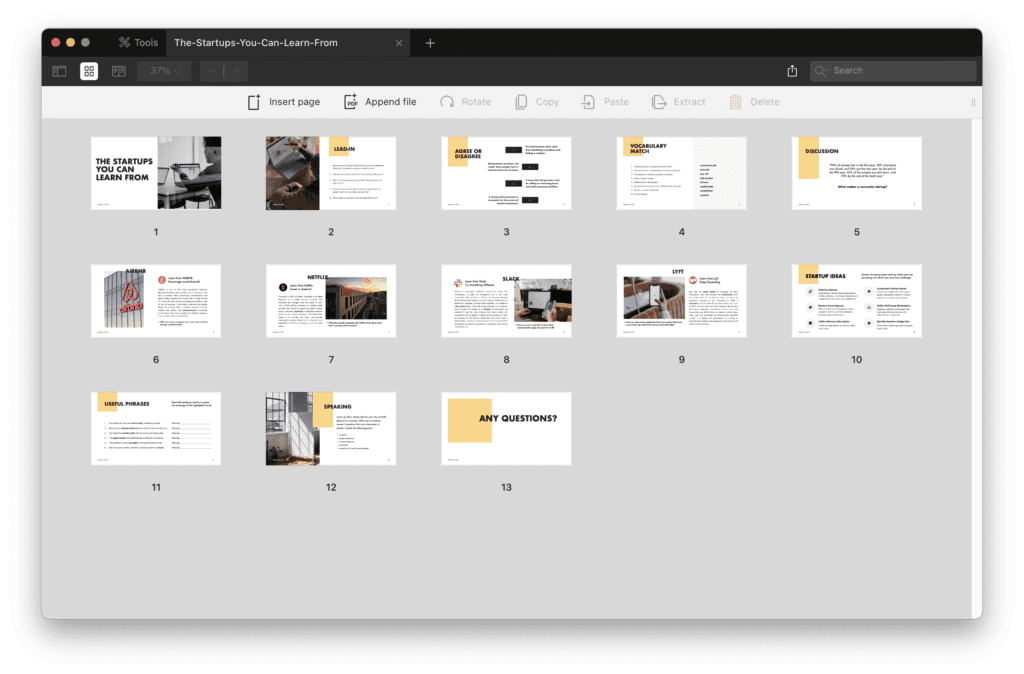
Start with the warm-up questions on page 2 to get students talking about entrepreneurship and businesses they like. Then do the “Agree or Disagree” activity. This works fine as pair work or a quick whole-class debate.
Do the vocabulary matching on page 4 before the case studies. Knowing these terms ahead of time makes the company examples easier to follow. Have students read each startup story (Airbnb, Netflix, Slack, Lyft) alone or in pairs, then talk through the reflection question after each one. This helps them connect what they’re reading to their own lives.
For the startup ideas activity on page 10, small groups work well. Students decide which ideas might succeed and which probably won’t; good practice for making arguments and thinking critically. On page 11, the “Useful Phrases” section covers startup vocabulary. Let students guess meanings from context first.
End with the speaking task where students pitch their own startup idea. Budget around 5 minutes per student for presentations and Q&A.
