
The Global Problem of Pirated Software

This C1 lesson examines the global problem of pirated software through real-world case studies and critical analysis. Advanced students explore the economic, security, and ethical dimensions of software piracy while building specialized vocabulary for discussing cybersecurity and intellectual property. The lesson uses an authentic article about counterfeit software in developing countries to spark debate and deeper thinking.
Lesson overview
- Explore ethical questions surrounding software piracy and affordability
- Learn specialized vocabulary related to cybersecurity and counterfeit products
- Develop critical reading skills through analysis of complex journalism
- Discuss global disparities in technology access and digital literacy
| Level | Vocabulary | Reading Time | Lesson Time |
| C1 / Advanced | 15 words | 1518 words / 8 min | 60-80 min |
Vocabulary
- malware
- compromised
- counterfeit
- earmark
- digital literacy
- pixelated
- repercussion
- deter
- eradicate
- in the dark
- replica
- pirated
- fake
- fraudulent
- phony
Contents
- Lead-in
- Stats
- Vocabulary preview
- Vocabulary
- Article
- Questions
- Vocabulary practice
- Discussion
- Explore
- Role-play
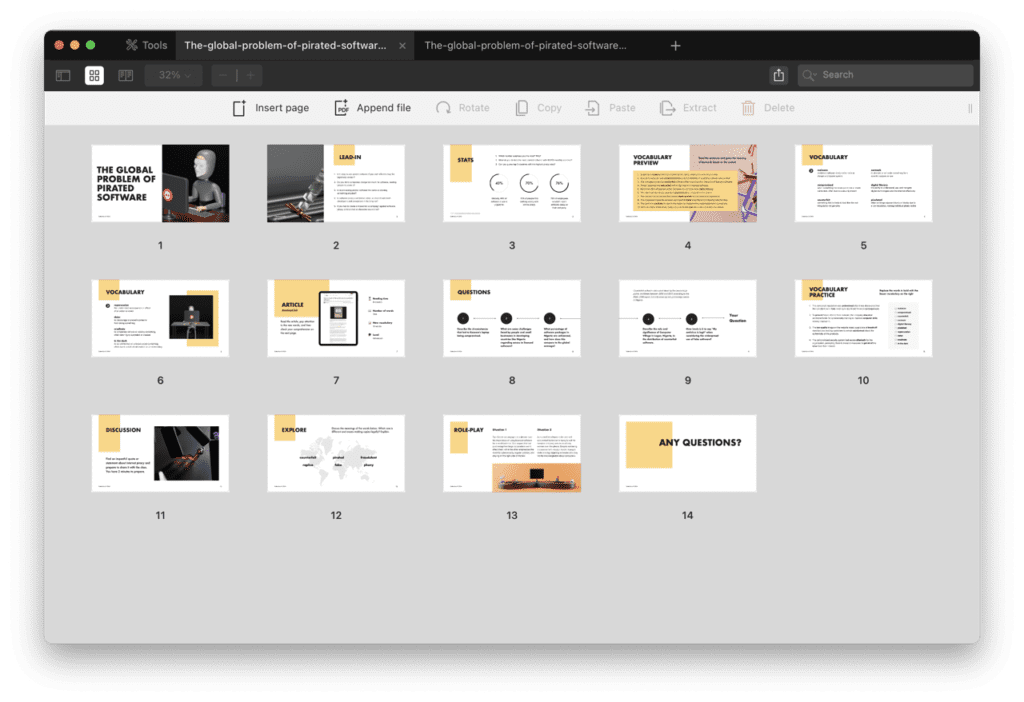
Open with the lead-in questions on page 2. These aren’t simple yes-or-no questions, so push students to think through multiple angles and real-world trade-offs. The statistics activity on page 3 works well for prediction and discussion before students see the actual data.
The vocabulary preview on pages 4-6 introduces ten technical terms students need for the reading. Have them guess meanings from context sentences first, then confirm with definitions. Guessing first helps the vocabulary stick. Make sure students understand the difference between “compromised” (made vulnerable) and “counterfeit” (fake), since both come up repeatedly in the article.
The main article runs about 1,500 words. This is dense material that discusses software piracy in Nigeria with specific examples and statistics. Before students read, give them a clear purpose: they’ll need to answer comprehension questions on pages 8-9 that cover both facts and implications. Use those questions afterward to check understanding and open up discussion about access, affordability, and consequences.
The vocabulary practice on page 10 uses substitution exercises. Students replace phrases with single vocabulary words, which tests whether they actually understand usage. The discussion activity on page 11 asks students to find and share quotes about internet piracy. Individual research first, then whole-class sharing.
End with one of the role-play scenarios on page 13. These put students in positions where they have to argue nuanced points using vocabulary and concepts from the lesson. The first scenario works for pairs. The second is trickier because students need to portray someone doing something ethically questionable without playing an outright scammer. Both demand the kind of language use you’d expect at C1 level.
