
Recessions Actually Make People Live Longer

This C1 lesson examines a counterintuitive finding that economic recessions can actually extend life expectancy by reducing pollution and changing behaviors. Students read a challenging article exploring the relationship between economic downturns and mortality rates, then discuss the complex trade-offs between economic growth and public health. The lesson introduces advanced economic vocabulary and encourages critical thinking about conventional assumptions regarding prosperity and wellbeing.
Lesson overview
- Explore advanced economic vocabulary including recession terminology and sustainability concepts
- Analyze research showing how economic downturns correlate with increased longevity
- Discuss complex relationships between economic growth, environmental health, and mortality rates
- Develop critical thinking skills by questioning assumptions about prosperity and wellbeing
| Level | Vocabulary | Reading Time | Lesson Time |
| C1 / Advanced | 10 words | 5 min / 883 words | 60-80 min |

Vocabulary
- malnourished
- mortality rate
- rule out
- fire on all cylinders
- corollary
- trade-off
- degrowth movement
- worse off
- stall
- stagnation
Contents
- Lead-in
- Agree or disagree
- Vocabulary preview
- Vocabulary
- Article
- Review
- True or false
- Vocabulary practice
- Pair work
- Wrap-up
- Extra
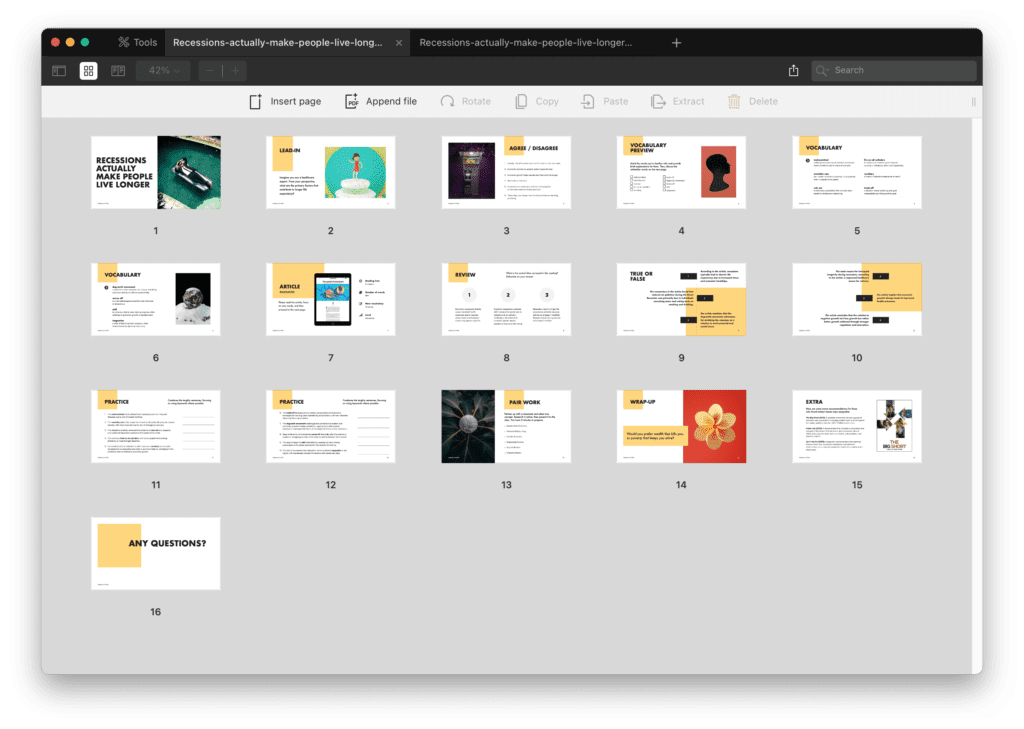
Begin with the lead-in question asking students to imagine they’re healthcare experts identifying factors that contribute to longer life expectancy. This gets them thinking about health determinants before introducing the surprising recession connection. The agree/disagree statements on page 3 preview claims that challenge common assumptions about economic growth and health.
Pages 4-6 introduce challenging vocabulary including terms like malnourished, mortality rate, fire on all cylinders, degrowth movement, and stagnation. Students first self-assess which terms they know, then study definitions together. This vocabulary is needed for following the economic and health arguments in the article.
The article on page 7 runs about 883 words and presents research showing that recessions extend life by reducing pollution and changing behaviors. Give students enough time to read independently before discussion. The comprehension activities on pages 8-10 check understanding through multiple choice questions about the central idea and true/false statements about specific claims.
Pages 11-12 provide vocabulary practice through sentence condensation. Students take long sentences using the new vocabulary and reduce them to keywords. This builds paraphrasing skills. The pair work on page 13 has students research and present economic concepts like circular economy, deglobalization, or lifestyle inflation.
The wrap-up question on page 14 poses a stark choice between wealth that kills you versus poverty that keeps you alive. This makes students sit with the article’s implications. The movie recommendations on page 15 suggest films about economic downturns for students interested in exploring further.
