
Phubbing: A Modern Bad Habit

This C1 lesson examines phubbing, the act of ignoring people by focusing on your phone instead. Students learn vocabulary like “snubbing,” “detrimental effect,” and “disengage,” then read an article about how phone habits damage relationships and mental health. The activities include analyzing personal screen time, identifying signs of phubbing, and discussing strategies to break the pattern.
Lesson overview
- Learn advanced vocabulary for phone addiction, relationship harm, and social disconnection
- Read about the psychological and relational consequences of habitual phone checking
- Analyze real scenarios from funerals to therapy sessions where phubbing crosses boundaries
- Practice summarizing complex information and completing personal reflection sentences
| Level | Vocabulary | Reading Time | Lesson Time |
| C1 / Advanced | 10 words | 993 words / 5 min | 60-80 min |
Vocabulary
- phubbing
- snubbing
- detrimental effect
- take a toll on
- perpetrator
- diminish
- disengage
- defensive
- confront
- intentional
Contents
- Lead-in 1
- Lead-in 2
- Vocabulary preview
- Definitions
- Article
- Summary 1
- Summary 2
- Pair-work
- Speaking
- Scan & Find
- Practice
- Quotes
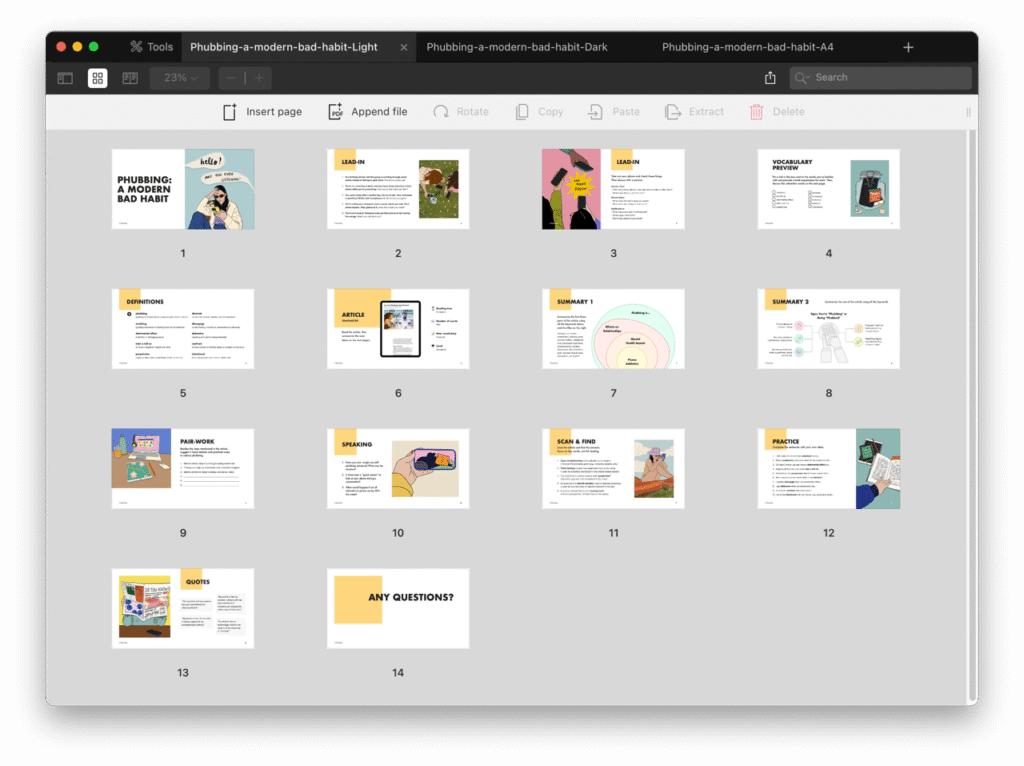
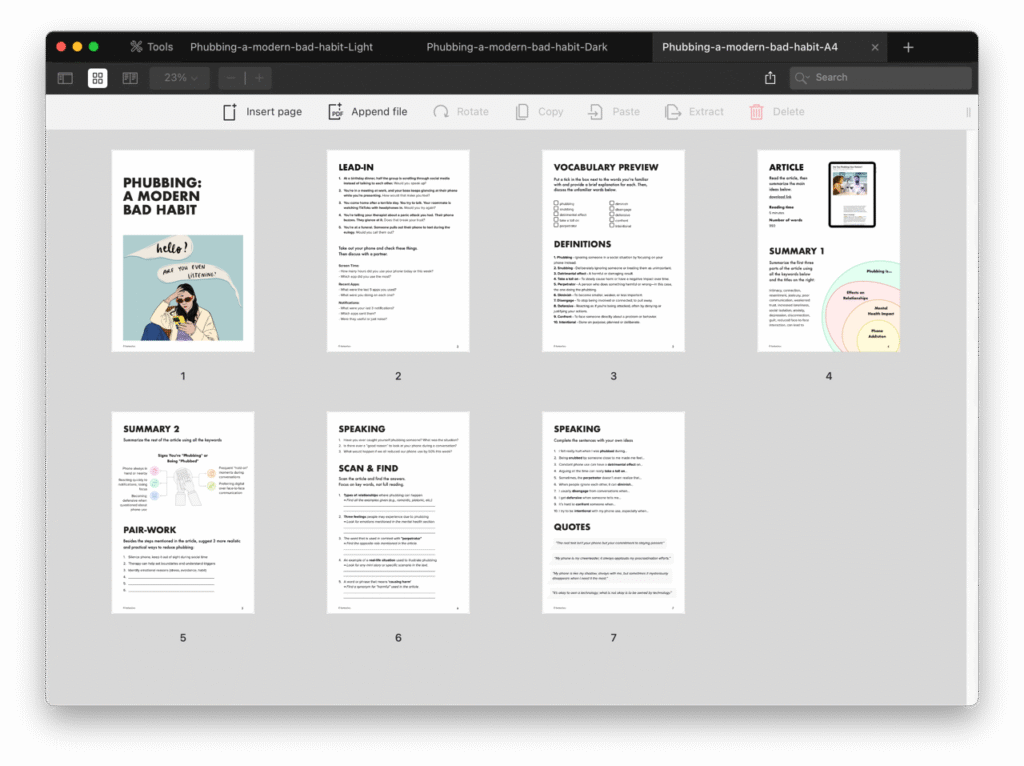
Start with the five scenario questions that put students in situations where phubbing happens. The birthday dinner and work meeting are common experiences, but the therapist and funeral scenarios are more extreme and usually provoke strong reactions. These get students thinking about context and severity before they know the term “phubbing.” The screen time activity has students check their actual phone data and discuss with a partner. This moment of truth often surprises people when they see their real usage numbers.
The vocabulary preview uses the tick box format. “Phubbing” combines “phone” and “snubbing,” which students might guess from context. Words like “perpetrator” and “detrimental” are broadly useful beyond just this topic, while “disengage” and “diminish” describe the erosion of connection that happens over time.
The article is just under 1000 words and covers what phubbing is, effects on relationships, mental health impact, phone addiction patterns, and signs you’re doing it or experiencing it. The first summary asks students to organize information from three sections using provided keywords like “intimacy,” “resentment,” and “anxiety.” The second summary focuses on behavioral signs using visual cues and short phrases. This dual approach to summarizing checks whether students can work with both conceptual content and concrete examples.
The pair-work task gives three strategies from the article and asks students to add three more realistic ones. This pushes them beyond just understanding the problem to thinking about practical solutions. The speaking questions include “Is there ever a good reason to look at your phone during a conversation?” which acknowledges that not all phone use is equal and emergency situations exist.
The scan and find activity sends students back to the article to locate specific information quickly. They find relationship types mentioned, emotions people feel, the word contrasted with “perpetrator” (which is “victim”), real-life scenarios used as examples, and synonyms for harmful. This practices scanning skills without requiring full rereading. The sentence completion practice has students finish statements using the vocabulary in personal contexts, like “I felt really hurt when I was phubbed during…” or “I get defensive when someone tells me…” The quotes at the end range from serious to humorous and give students a chance to react to different perspectives on phone dependence.
