
Handling Online Meetings

This B1 lesson teaches students essential language and etiquette for handling online meetings professionally. Students learn common phrases used in virtual meetings, practice listening to meeting scenarios, and discuss the challenges of remote work. The lesson combines a fun Zoom quiz, vocabulary matching, and role-play situations.
Lesson overview
- Practice using professional phrases for managing virtual meetings effectively
- Learn vocabulary for common online meeting situations and technical issues
- Develop listening skills through authentic meeting recordings and scenarios
- Discuss the advantages and challenges of remote work environments
| Level | Vocabulary | Listening Time | Lesson Time |
| B1 / Intermediate | 9 phrases | 3 min | 60 min |
Vocabulary
- “Let’s circle back to that later.”
- “Sorry, I was on mute.”
- “Any questions so far?”
- “I have a hard stop at [time].”
- “Let’s schedule a follow-up meeting.”
- “Let’s stay on track.”
- “What are your thoughts on this?”
- “We have a few minutes left, any final thoughts?”
- “Feel free to use the chat for questions or comments.”
Contents
- Lead-in
- Quiz
- Short reading
- Vocabulary match
- Listening 1
- Comprehension and transcript
- Listening 2
- Comprehension and transcript
- Situations
- Discussion
- Game
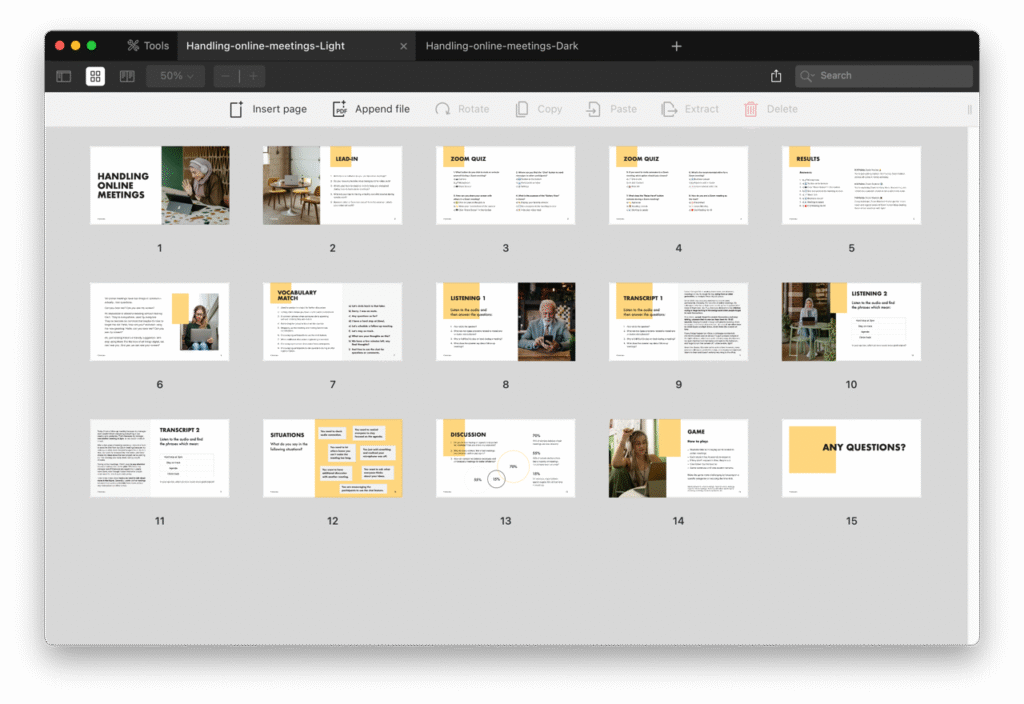
Start with the lead-in questions about students’ experiences with online meetings. Most working students will have plenty to share about virtual backgrounds and home office setups. The Zoom quiz on pages 3-5 works as a lighthearted warm-up. Students can do it alone first, then compare answers in pairs before you reveal the correct ones. The results section usually gets laughs when students find out they’re “Zoom Novices.”
The reading on page 6 about overused meeting phrases (“Can you hear me?”) sets up the vocabulary work. Have students read it aloud in pairs using exaggerated voices for humor. Then move to the vocabulary matching on page 7. These phrases are the real value of the lesson since students can use them right away in their own meetings. Drill pronunciation of tricky ones like “circle back” and “hard stop.”
For Listening 1 on pages 8-9, warn students that the speaker is older and somewhat negative about online meetings. This prepares them for the tone. After the first listen, let students discuss what they caught before playing it again. Listening 2 on pages 10-11 gives the opposite view from a younger worker who prefers remote meetings. Have students compare the two speakers’ attitudes.
The situations practice on page 12 is where everything comes together. Students practice the phrases from page 7 in realistic contexts. You can do quick-fire drilling first, then have students create mini-dialogues using multiple phrases. For stronger classes, throw in unexpected complications like “Your cat just walked across your keyboard” or “Someone’s doorbell keeps ringing.”
The discussion on page 13 about meeting statistics gets good conversation going. Many students will strongly agree that most meetings could have been emails. Let it run rather than cutting it short. The game on page 14 works best with 6-8 students. For larger classes, split into groups. Start with easier categories like “Tools for online meetings” before moving to trickier ones like “Bad things to do during a meeting.”
