
Money, Happiness, & Hedonic Adaptation

This C1 lesson explores the relationship between money and happiness, with a focus on hedonic adaptation. Students analyze data from a global study, learn terms like “satiation point” and “subjective wellbeing,” and listen to four audio clips about why earning more doesn’t always mean feeling better. It’s the kind of topic where everyone walks in with an opinion and leaves thinking differently.
Lesson overview
- Learn ten vocabulary terms related to happiness research and income psychology
- Listen to four audio clips and complete true or false, note-taking, gap-fill, and comprehension tasks
- Analyze how geography, household size, and comparison affect the money-happiness link
- Debate wealth distribution and hedonic adaptation in a structured fishbowl discussion
| Level | Vocabulary | Listening Time | Lesson Time |
| C1 / Advanced | 10 words | 8 min | 60 min |

Vocabulary
- Subjective wellbeing
- Life evaluation
- Household income
- Emotional wellbeing
- Satiation point
- Hedonic adaptation
- Contentment
- New normal
- Superior
- Inferior
Contents
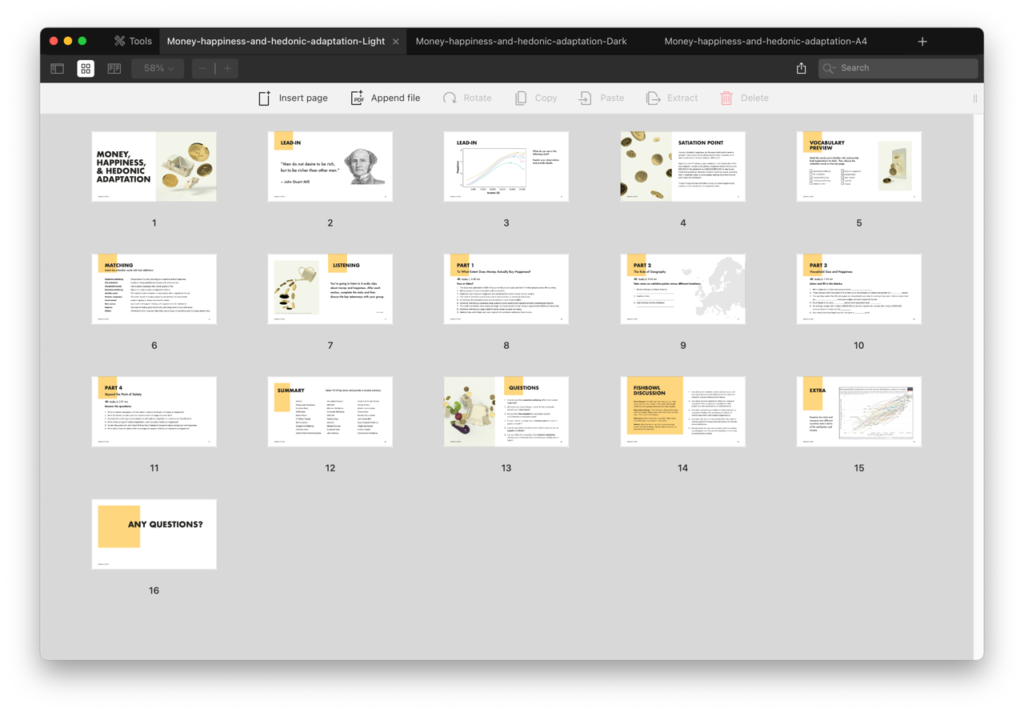
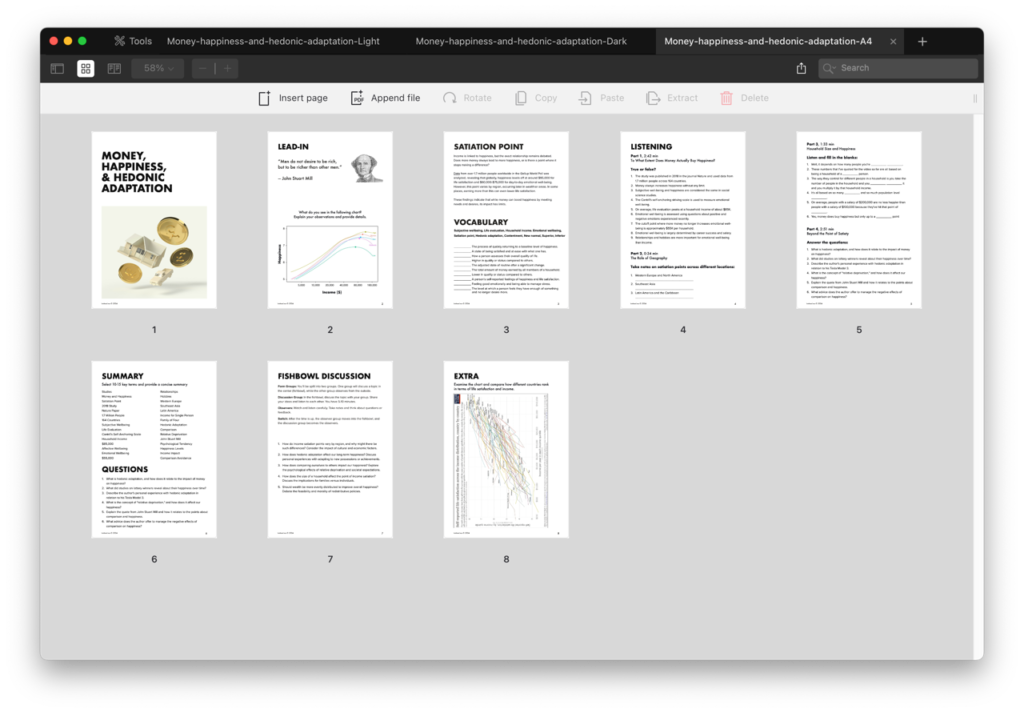
- Lead-in (quote)
- Lead-in (chart)
- Satiation point
- Vocabulary preview
- Matching
- Listening
Part 1 – True or false
Part 2 – Notes
Part 3 – Fill in the blanks
Part 4 – Questions - Summary
- Questions
- Fishbowl discussion
- Extra chart
Open with the John Stuart Mill quote about wanting to be richer than other people, not just rich. Ask students if they agree and why. Then show the income-happiness chart and have students describe what they see. Most will notice that happiness rises with income but eventually flattens out. This visual sets up the satiation point concept nicely. Read through the short explanation text together and check if the numbers surprise anyone. The finding that happiness levels off around $95,000 for life satisfaction usually gets a reaction.
Cover the ten vocabulary words next. Have students mark which ones they already know, explain those briefly, then work through the matching activity for the rest. “Hedonic adaptation,” “satiation point,” and “subjective wellbeing” are the heavy hitters here. Spend time on these three because they come up repeatedly in the listening section. Make sure students can say them confidently and use them in a sentence before moving on.
The four audio clips form the core of the lesson. Each one has a different task type. Part one is true or false about the 2018 Nature study. Part two asks students to take notes on satiation points across regions. Part three is a gap-fill about household size and income. Part four covers hedonic adaptation with open comprehension questions. Play each clip once, let students attempt the task, then play it again to check and fill in gaps. The parts build on each other, so keep the order as presented. After finishing all four, the summary slide asks students to pick ten to fifteen key terms and give a short spoken summary. This pulls everything together.
Wrap up with the discussion questions and the fishbowl activity if your class is large enough. The fishbowl works well because it forces active listening from observers while the inner group debates topics like wealth redistribution and the psychology of comparison. For smaller classes, skip the fishbowl format and run the questions as a regular group discussion. The extra slide with the country comparison chart makes a good final talking point or homework task.
