
Materials

This lesson plan introduces A2 level students to common materials vocabulary through visual recognition and practical description tasks. Students learn to identify and describe everyday objects by their materials, from wood and metal to fabric and ceramic. The lesson combines guessing games, scavenger hunts, and speaking activities to build confident material descriptions in real-world contexts.
Lesson overview
- Learn vocabulary for ten common materials found in everyday objects
- Practice describing objects using color, material, and physical properties
- Develop speaking skills through interactive guessing and scavenger hunt games
- Explore idioms and expressions related to materials in English
| Level | Vocabulary | Lesson Time |
| A2 / Pre-Intermediate | 10 words, 4 idioms | 60-80 min |
Vocabulary
- Wood
- Metal
- Plastic
- Glass
- Fabric
- Paper
- Leather
- Rubber
- Ceramic
- Stone
- Plastic surgery
- Glass half full/half empty
- Glass ceiling
- To have a heart of gold
Contents
- Lead-in 1
- Lead-in 2
- Quiz – 10 slides
- Vocabulary
- Language tip
- Practice 1
- Practice 2
- Scavenger hunt
- Discussion
- Idioms
- Practice
- Speaking
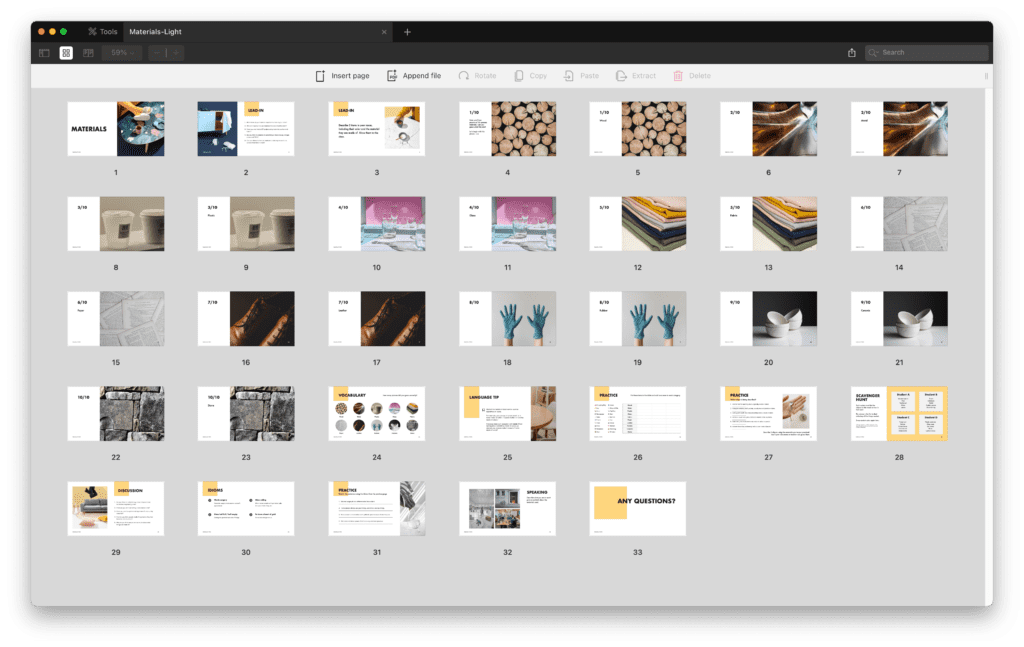
Start with the lead-in questions on page 2 to get students thinking about materials around them. These work well in pairs or small groups. The activity on page 3 asks students to find three items in their room and describe them using materials vocabulary. Works great in online classes where students can grab items and show them on camera.
The main vocabulary presentation runs from pages 4-23 with a visual guessing game. Show each image one at a time and let students guess the material before revealing the answer. This keeps things moving and helps with retention. After going through all ten materials, use the review on page 24 to pull it together.
The language tip on page 25 covers an important grammar point. Most material words work as both nouns and adjectives, but “wood” becomes “wooden” when used as an adjective. Give students a few minutes to practice this pattern.
The practice activities on page 26 work well as pair work. Students categorize household items by material and add their own examples. The object description activity on page 27 builds descriptive language. Students guess each object before moving on.
The scavenger hunt on page 28 is the main speaking activity. In classrooms, students race to find real objects. Online students can search for images quickly. Gets everyone moving and talking. The discussion questions on page 29 push students to think about quality, sustainability, and consumer choices.
Wind down with the idioms section on pages 30-31. These add some cultural knowledge and connect materials vocabulary to common phrases. The speaking activity on page 32 uses photos to practice descriptions. Students focus on what they see and how materials contribute to each scene.
