
Making a Complaint

This A2 lesson teaches students how to make polite complaints in restaurants, shops, and hotels. They learn vocabulary like “faulty,” “refund,” and “resolve,” then read tips for complaining effectively. The activities include listening to complaint dialogues, identifying polite versus rude language, practicing sentence completion, and role-playing three common complaint scenarios.
Lesson overview
- Practice complaint vocabulary including product problems, refund requests, and problem resolution
- Read practical tips for staying calm, explaining issues clearly, and asking for specific solutions
- Listen to two authentic complaint dialogues showing effective customer-employee communication
- Build conversation skills through three role-plays covering late deliveries, wrong orders, and hotel problems
| Level | Vocabulary | Audio Length | Lesson Time |
| A2 / Pre-Intermediate | 10 words | 0:57, 0:53 min | 60 min |


Vocabulary
- complaint
- issue
- damaged
- resolve
- refund
- faulty
- rude
- reasonable
- replace
- manager
Contents
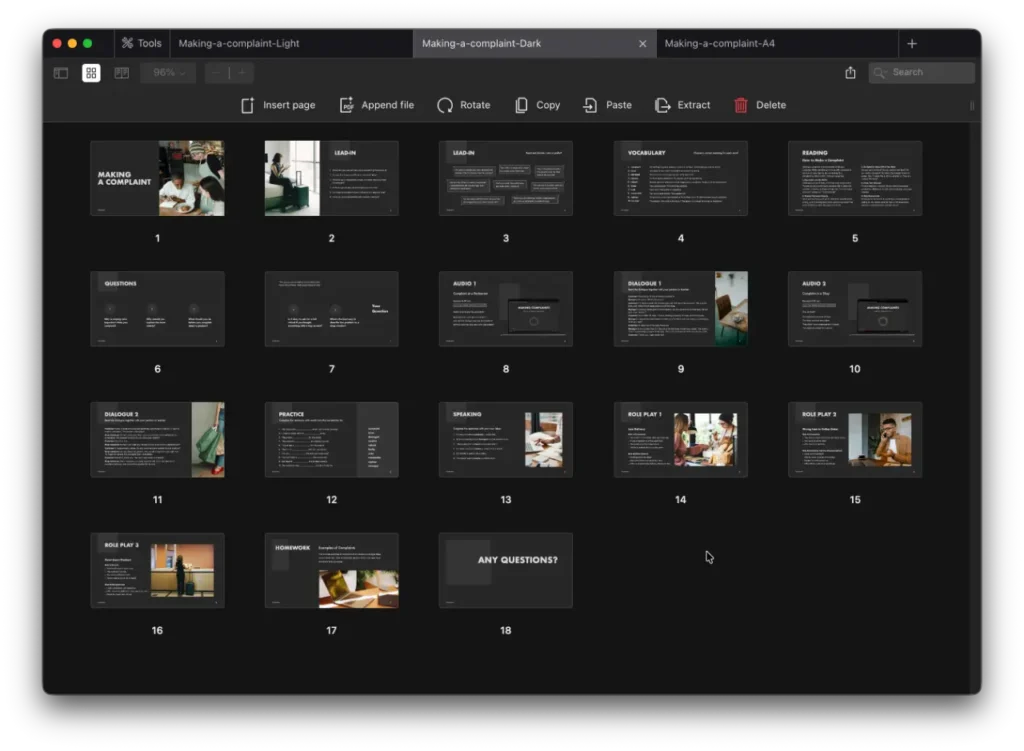
- Lead-in
- Vocabulary
- Reading
- Questions
- Audio 1
- Dialogue 1
- Audio 2
- Dialogue 2
- Speaking
- Practice
- Role-plays
- Homework
Start with the lead-in questions about recent complaint experiences and cultural attitudes toward complaining. A2 students can share basic stories using simple past tense. The activity on slide 3 shows eight complaint statements. Students decide which ones sound polite and which sound rude. This introduces the key lesson point that what you say matters less than how you say it.
The vocabulary matching teaches ten essential complaint words. Make sure students understand the difference between “damaged” (physically broken) and “faulty” (doesn’t work properly) since both describe product problems but in different ways. “Resolve” means to fix or solve, which appears frequently in customer service contexts. After matching definitions, students see these words used naturally throughout the lesson.
The reading passage gives six practical tips for complaining effectively. It emphasizes staying calm because the employee probably didn’t cause the problem, explaining issues clearly with specific details, and being reasonable about solutions. The advice about keeping receipts is practical and universally applicable. After reading, students answer comprehension questions testing whether they understood why calmness helps and what makes a request reasonable.
The first audio runs 57 seconds and shows a restaurant complaint about slow service. The customer waited 30 minutes for pasta and has a meeting soon. The manager apologizes, asks for the order number, and offers the meal free because of the delay. Students answer whether the customer stayed calm and reasonable, which they did by explaining the problem politely instead of yelling.
After listening, students read the full dialogue together. This reinforces pronunciation and lets them notice useful phrases like “I’d like to make a complaint” and “I sincerely apologize.” The second audio runs 53 seconds and covers a shop complaint about a damaged sweater with a hole. The shop assistant checks stock, offers replacement or refund, and resolves the issue quickly. Students complete true/false statements testing specific details.
The practice sentences require students to fill blanks with complaint vocabulary. After that, sentence completion personalizes the topic by asking how they feel when making complaints, what they do when items arrive damaged, and how they’d handle rude workers. These connect abstract vocabulary to real feelings and reactions.
The three role-plays provide controlled speaking practice. The first covers a late birthday cake delivery with a party starting in two hours. The second deals with receiving wrong-colored shoes from an online order. The third involves a noisy, dirty hotel room with three nights remaining. Each scenario recycles the vocabulary naturally while building confidence for real complaint situations.
For homework, students find 2-3 real complaint examples from Google Maps reviews or social media, take screenshots, and present them in the next class. This connects classroom language to authentic complaints and shows how people actually express dissatisfaction online.
