
Luxury Fashion is for Broke People

This advanced-level lesson explores why middle-class consumers drive luxury fashion markets more than the wealthy do. Students examine status symbols, income inequality, and consumer psychology through reading and debate. The lesson challenges assumptions about who buys designer brands and why people purchase items they can’t afford.
Lesson overview
- Analyze the relationship between income inequality and luxury consumption patterns
- Practice advanced vocabulary related to wealth, status, and consumer behavior
- Discuss the psychology behind status symbol purchases and social signaling
- Evaluate arguments about authentic luxury versus conspicuous consumption
| Level | Vocabulary | Reading Time | Lesson Time |
| C1 / Advanced | 16 words and 14 phrases | 4 min / 611 words | 60 min |
Vocabulary
- Allure
- Conspicuous
- Endorse
- Pinnacle
- Flaunt
- Discreet
- Affluence
- Chastise
- Counterfeit
- Inventory
- Exude
- Ostentatious
- Obnoxious
- Counterpart
- Unattainable
- Indulgence
- Rolling in dough
- Down and out
- Living the high life
- Loaded
- Balling out
- Living paycheck to paycheck
- Strapped for cash
- Filthy rich
- Flat broke
- Barely scraping by
- Money talks
- Stacking paper
- Living large
- Born with a silver spoon
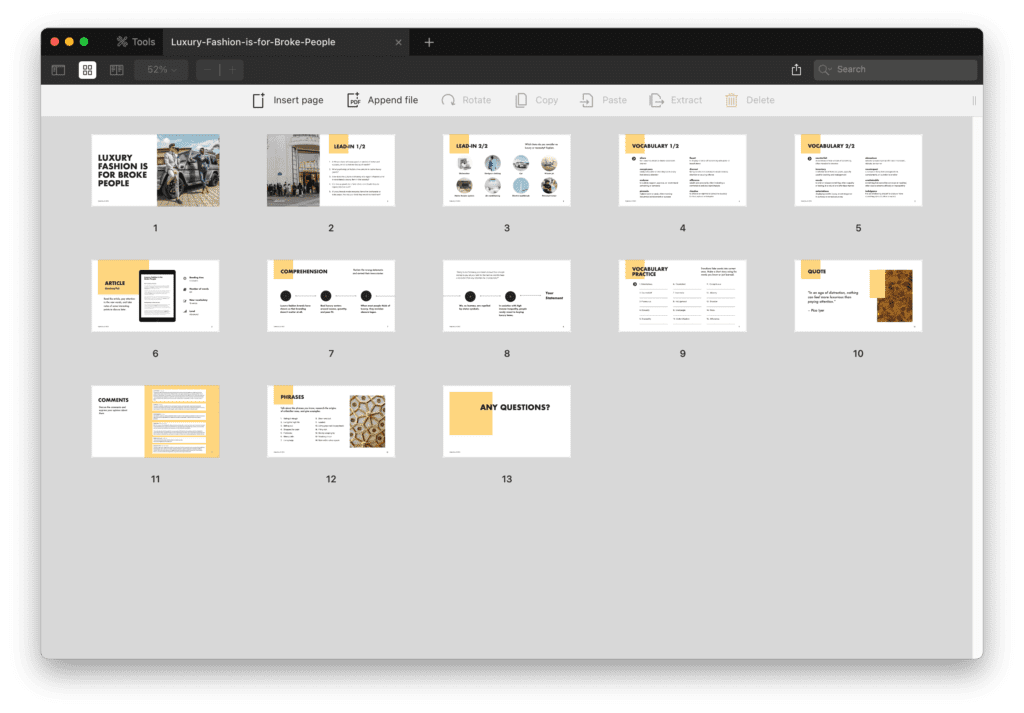
Contents
- Lead-in 1
- Lead-in 2
- Vocabulary
- Article
- Comprehension
- Vocabulary practice (fake words)
- Quote
- Comments
- Useful phrases
Start with the warm-up on page 2 to get students thinking about luxury as status versus art. The questions about marketing luxury toothpaste are good for loosening up the class. Then do the luxury versus necessity activity on page 3. Students often disagree about cars and air conditioning, which gets conversation going.
Pre-teach the vocabulary on pages 4-5 before the reading. Focus on words like “conspicuous,” “flaunt,” and “ostentatious” since they come up a lot in the article. Have students read the 611-word article on their own and take notes. Takes about 10 minutes for most advanced students.
After reading, use the comprehension check on pages 7-8. Students correct false statements about branding and status symbols. The vocabulary practice on page 9 has students turn fake words into real ones, which usually gets some laughs. If there’s time, they can write short stories using the corrected words.
The comment discussion on page 11 tends to generate the most conversation. Students react to real perspectives about wealth and fashion from different social classes. The phrases activity on page 12 teaches idioms like “rolling in dough” and “living paycheck to paycheck.” Wrap up by revisiting the opening questions now that students have new vocabulary and ideas to work with.
