
Love & Relationships

This B1 lesson covers common English phrases for talking about love and relationships. Students learn expressions like “have a crush on,” “break up with,” and “work things out” through a short story, matching exercises, and speaking activities. It’s a fun one to use around Valentine’s Day or any time your class enjoys personal topics.
Lesson overview
- Learn 10 common English phrases for talking about love and relationships
- Read a short story and identify relationship vocabulary in context
- Practice using love phrases through debates, gap fills, and picture descriptions
- Discuss cultural attitudes toward dating, breakups, and showing affection
| Level | Vocabulary | Lesson Time |
| B1 / Intermediate | 10 phrases | 60 min |


Vocabulary
- Have a long-distance relationship
- Love at first sight
- Have a crush on
- Ask someone out
- Get engaged
- Break up with someone
- Get back together
- Cheat on someone
- Show affection
- Work things out
Contents
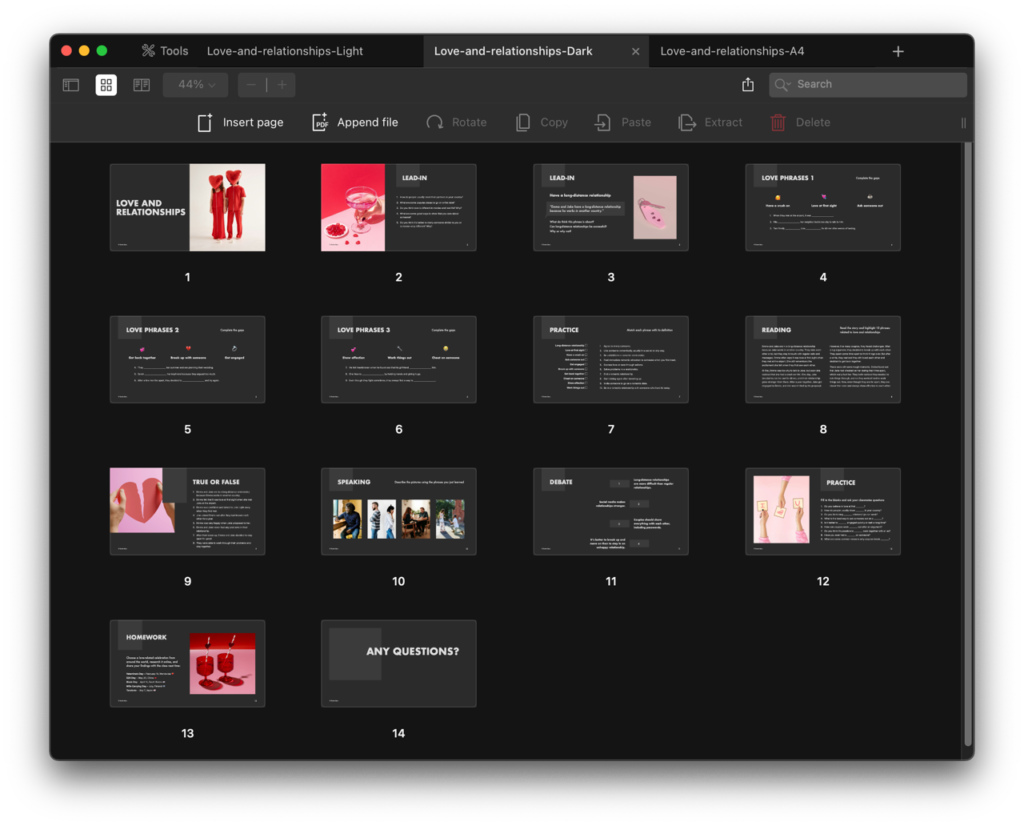
- Lead-in 1
- Lead-in 2
- Love phrases 1
- Love phrases 2
- Love phrases 3
- Matching
- Reading
- True or false
- Pictures
- Debate
- Vocabulary practice
- Homework
Start with the lead-in questions on slide 2. Questions about how people meet their partners or what makes a good first date usually get B1 students talking right away. Slide 3 introduces the phrase “long-distance relationship” with a short example sentence and a quick discussion question. This sets up the vocabulary that comes next.
Slides 4 through 6 present nine love phrases in groups of three. Each group has a gap-fill exercise, so students see the phrases in context before they have to produce them. Go through these together and check answers as a class. The matching exercise on slide 7 is a good way to review all the phrases before moving into the reading. Don’t skip it, because students often mix up “get back together” and “work things out” at this level.
The reading on slide 8 tells the story of Emma and Jake using all 10 relationship phrases. Have students read it once and highlight the phrases they find. Then do the true or false questions on slide 9. This reading works well in pairs, with students comparing their answers before you check as a class.
The second half of the lesson is mostly speaking. Slide 10 has pictures for students to describe using the new phrases, which is a nice low-pressure activity. The debate topics on slide 11 are where things get interesting. Topics like “couples should share passwords” and “social media makes relationships stronger” tend to split the room. Finish with the gap-fill discussion questions on slide 12. Students fill in the missing words, then use the questions to interview a partner. For homework, each student picks a love-related celebration from around the world and prepares a short presentation for the next class.
