
How to Invite & Respond

This A2 lesson teaches students how to invite people to activities and respond politely. They practice phrases like “Would you like to…?” and “Sorry, I can’t because…” through reading, quizzes, and a fun speaking game. It is perfect for beginners who want to sound natural in everyday social situations.
Lesson overview
- Learn common phrases for inviting, accepting, and declining in English
- Read two short dialogues about making plans with friends
- Practice sentence structure through unscramble and gap-fill activities
- Play a speaking game where students make and turn down invitations
| Level | Vocabulary | Lesson Time |
| A2 / Pre-Intermediate | 11 phrases | 60 min |


Vocabulary
- Do you want to…?
- Would you like to…?
- How about…?
- Let’s…
- Sure! That sounds great!
- Yes, I’d love to!
- Okay, what time?
- That would be fun!
- Sorry, I can’t because…
- I’d love to, but…
- Maybe next time!
Contents
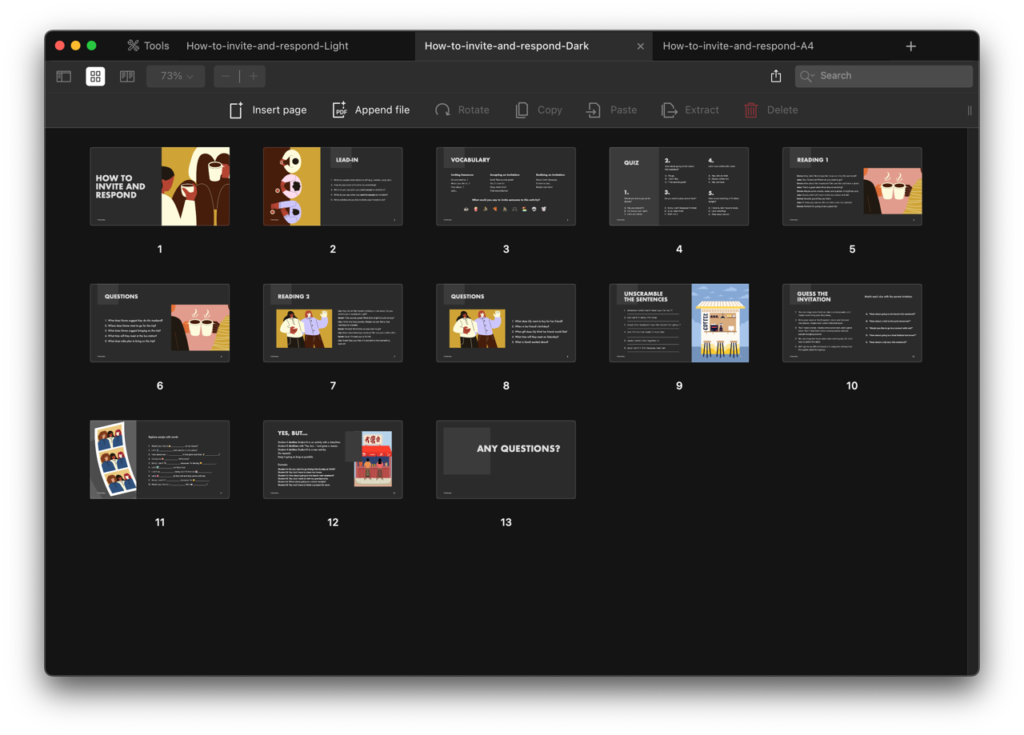
- Lead-in
- Vocabulary
- Quiz
- Reading 1
- Questions
- Reading 2
- Questions
- Unscramble the sentences
- Guess the invitation
- Yes, but
Start with the lead-in questions. Keep it simple and give examples if students are unsure. At A2 level, some might only say “go to cinema” or “eat pizza,” and that is perfectly fine. The goal is to get them thinking about invitations before you introduce the target language. Once they have shared a few ideas, show the vocabulary slide with the invitation phrases. Read through each category together: inviting, accepting, and declining. Have students repeat the phrases aloud a couple of times. Then ask them to pick an activity from the emoji list and practice inviting a partner using one of the phrases.
The quiz on the next slide checks whether students can recognize correct responses. Go through each question and discuss why the wrong answers do not work. This is a good chance to point out common A2 mistakes like “No go” or “Let’s watching.” After the quiz, move into the two reading dialogues. These are short and use the target phrases in context. Read them aloud together or have students read in pairs. The comprehension questions are straightforward, so students should manage them without too much help.
The unscramble activity gives students practice building sentences with the target structures. Let them work in pairs and check answers together. After that, the “Guess the Invitation” matching exercise is a nice change of pace. Students read descriptions and match them to the correct invitation phrase. The emoji gap-fill on the following slide pushes students to produce their own words, which is good preparation for the final speaking task.
End with the “Yes, But…” game. This is where the lesson comes alive. One student invites, the other declines with an excuse, and they keep going back and forth without repeating activities. Model the example first so everyone understands the format. Set a timer for three minutes and see which pair can keep the longest chain going. Students enjoy the challenge, and it gives them real practice using all three phrase types in a natural way.
