
How to Express Opinions

This B1 intermediate lesson teaches students effective ways to express and support their opinions in English. Students learn alternatives to overusing “I think” and practice structured argumentation through debates and discussions. The lesson builds confidence in sharing viewpoints, agreeing, disagreeing, and defending positions on everyday topics.
Lesson overview
- Practice expressing opinions using varied phrases beyond basic expressions
- Learn structured argumentation with the opinion-reason-example format
- Develop debate skills through presentation and counter-argument activities
- Explore agreement and disagreement language for respectful conversations
| Level | Vocabulary | Lesson Time |
| B1 / Intermediate | 24 phrases | 60 min |
Vocabulary
- From my point of view
- In my opinion
- Honestly, I find
- I believe that
- I believe
- I guess
- Personally, I feel
- If you ask me
- I would say that
- It seems to me that
- I absolutely agree.
- I think the same.
- You’re right.
- That’s true.
- I have the same opinion.
- I couldn’t agree more.
- No question about that!
- I don’t think so.
- I doubt that.
- I see it differently.
- I’m not so sure about that.
- I appreciate your viewpoint, but
- That’s not true!
- Hell no! It makes no sense.
Contents
- Lead-in
- Reading
- Phrases
- Structure
- Practice
- Questions
- Brainstorm
- Phrases
- Agree or disagree
- Debate
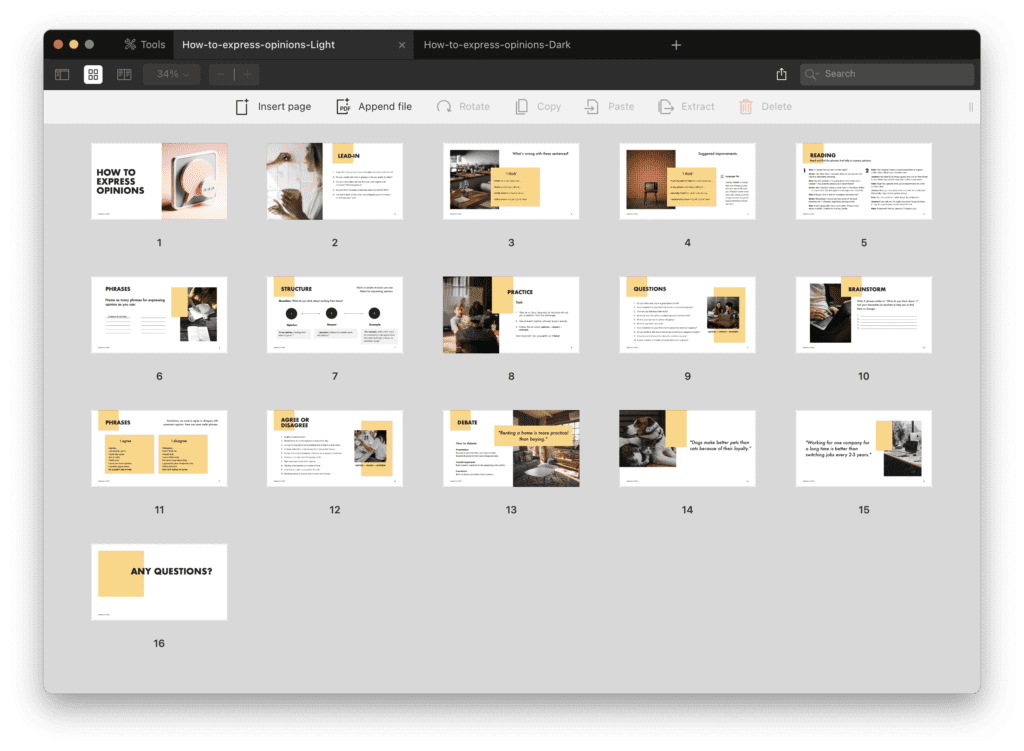
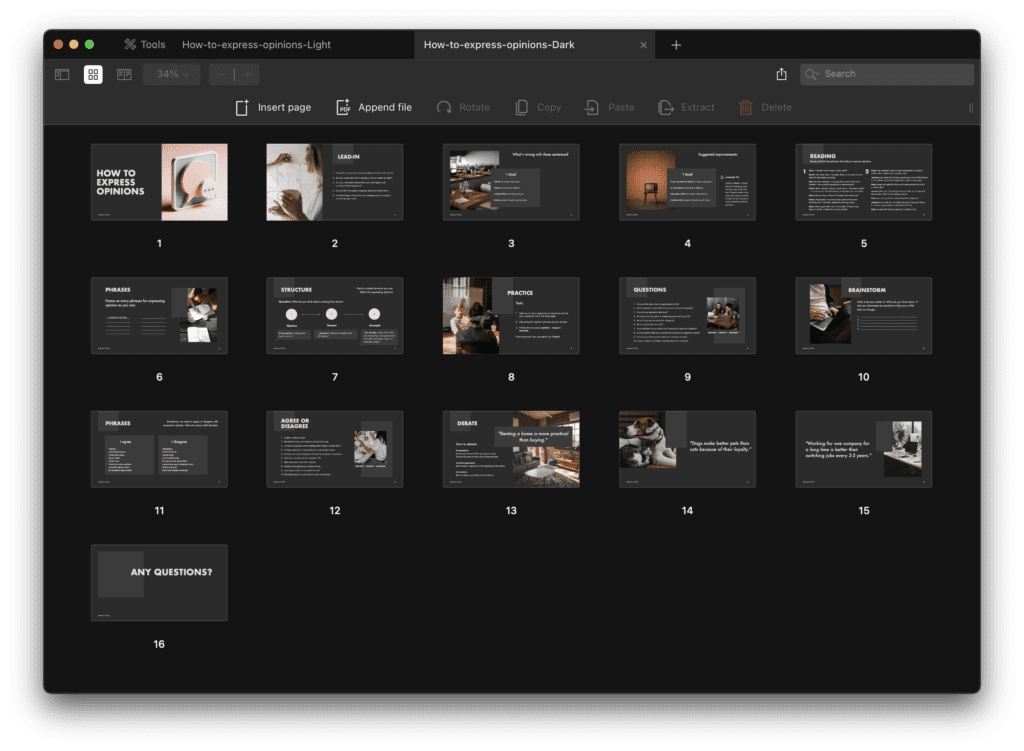
Start with the lead-in questions on page 2 about sharing opinions. Students discuss how often they express views and whether online communication makes it easier. On page 3, students look at what’s wrong with repetitive “I think” sentences. This shows whether they already see the need for variety.
Show the improved versions on page 4 and explain how mixing expressions makes English sound more natural. The reading on page 5 has two dialogues where students spot opinion phrases in context. This leads into page 6 where they list as many opinion expressions as they can. You can make it a competition between pairs or groups.
Introduce the three-part structure on page 7 with the work-from-home example. Make sure students understand they need all three elements. The practice on pages 8-9 has students answer questions using at least three opinion phrases while avoiding “I think.” This forces them to try new language. Give 2-3 minutes prep time per question and have them practice in pairs.
Page 10 asks students to find five alternative ways to ask for opinions. Present the agreement and disagreement phrases on page 11 before moving to page 12 where students respond to ten statements. Push them to back up their positions with reasons and examples.
The debate activities on pages 13-15 are the main speaking practice. Explain the format clearly before they start. Assign positions randomly so students practice arguing for views they might not hold personally. Monitor and note strong examples and common errors for feedback. Finish by reviewing key phrases and asking which new expressions they plan to actually use.
