
How Consumerism Ruins Our Planet and Finances

This powerful C1 level lesson examines how modern consumerism affects both personal finances and the environment. Students will analyze compelling statistics about consumer spending, explore advanced vocabulary related to economics and sustainability, and engage in critical discussions about their own purchasing habits. The lesson features a thought-provoking article, creative writing tasks, and debate opportunities, making it ideal for advanced learners ready to tackle complex societal issues with nuanced language skills.
Lesson overview
- Examine the psychological and financial impact of constant advertising exposure
- Learn sophisticated vocabulary related to consumerism, economics, and environmental issues
- Develop critical analysis skills through article comprehension and structured debate
- Practice creative writing using sarcasm and persuasive techniques
| Level | Vocabulary | Reading Time | Lesson Time |
| C1 / Advanced | 16 words | 4 min / 492 words | 60 min |
Vocabulary
- Onslaught
- Permeating
- Surge
- Staggering
- Down payment
- Indulgence
- Perpetual cycle
- Financial strain
- Disentangle from
- Repercussions
- Insatiable
- Undermining
- Exacerbating
- Amplified
- Yield
- Blueprint
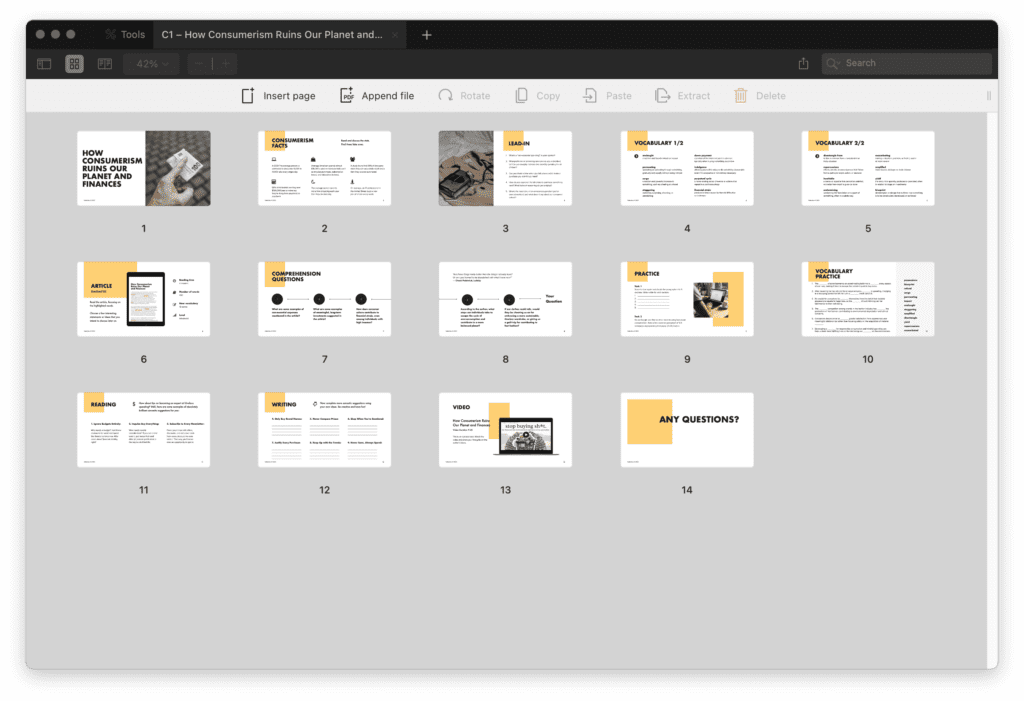
Contents
- Consumerism facts
- Lead-In
- Vocabulary 1
- Vocabulary 2
- Article reading
- Comprehension questions
- Practice
- Vocabulary practice
- Reading
- Writing
- Video
Start with the stats activity on page 2. Students read six consumer facts and figure out which three are bogus. This grabs their attention immediately and gets their critical thinking going. The real statistics are crazy enough that people will naturally start talking about spending habits. Let pairs argue over which facts sound fishy before you reveal the answers.
Move to the lead-in questions on page 3. These five prompts get students thinking about their own spending patterns and how much they blow on subscriptions. Question three about feeling pressured to buy stuff really resonates with most people. Make it a judgment-free space where students can be real about impulse buying or how advertising gets to them.
Pages 4 and 5 introduce some tough vocab like “onslaught,” “permeating,” and “insatiable.” These words show up in the main article, so teaching them beforehand makes sure students can follow what they’re reading. Use the definitions and have them create their own example sentences. Advanced learners really benefit from digging into the subtle differences between synonyms.
The article on page 6 is 492 words and takes around four minutes to read. Have students read independently while highlighting interesting stuff they want to discuss. The comprehension questions on pages 7 and 8 check if they understood the main ideas like non-essential spending and environmental impact. Push them to point to specific passages when they answer.
Page 9 has two great practice tasks. Task one makes students divide the article into sections and create titles, which builds organizational skills. Task two sends them online to find more consumerism facts and write a short paragraph, mixing research with academic writing practice.
The vocab practice on page 10 reinforces new terms through gap-fill sentences. The sarcastic tips activity on pages 11 and 12 gives everyone a fun break while driving home the themes. Students complete funny suggestions for wasteful spending like “Only Buy Brand Names.” This playful approach helps advanced learners get the hang of irony in English.
Wrap up by discussing which strategies students might actually use to cut back on unnecessary buying.
