
Gen Z & Boomers Vs. Online Scams

This C1 advanced lesson challenges common assumptions about online scams by revealing that Gen Z falls victim more often than older generations. Students examine why digital natives face higher scam risks despite their tech familiarity, exploring factors like convenience prioritization, constant device usage, and inadequate cybersecurity education. Through article analysis, vocabulary practice with intentionally incorrect definitions, and role-play activities simulating common scams, learners develop critical thinking about online safety while practicing advanced English.
Lesson overview
- Analyze why Gen Z experiences more online scams than older generations
- Learn vocabulary related to cybersecurity threats, including phishing and impersonation
- Practice identifying scam tactics through interactive role-play scenarios
- Evaluate responsibility distribution between users and technology platforms for online safety
| Level | Vocabulary | Reading Time | Lesson Time |
| C1 / Advanced | 10 words | 7 min / 1297 words | 60-80 min |
Vocabulary
- Surge
- Vulnerable
- Incentivize
- Dissimilar
- Bogus
- Digitally savvy
- Fall for
- Impersonation
- Compromised account
- Mayhem
Contents
- Lead-in 1
- Lead-in 2
- Vocabulary
- Article reading
- Agree or disagree
- Vocabulary practice
- 5 role-play scenarios
- Speaking
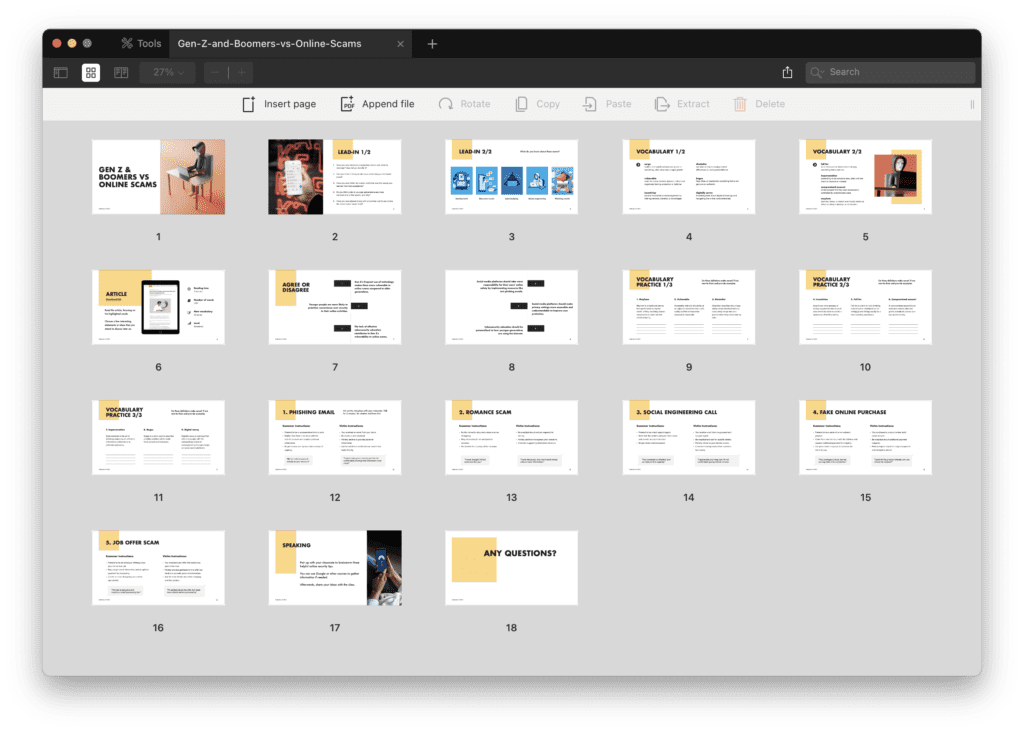
Start with the warm-up questions on page 2. Question four asks students to guess which generation falls for scams more often. Most will probably say older people, so it’s a nice surprise when the article flips that assumption. Spend three minutes on pair discussions before moving on.
Page 3 shows five common scam types through visuals. Give students two minutes to share what they already know about each one. This taps into prior knowledge and shows why cybersecurity vocab matters.
Pages 4-5 have ten vocabulary items. Spend about six minutes here, focusing on pronunciation and example sentences. Terms like digitally savvy and compromised account come up a lot in the article and role-plays.
The article on page 6 is 1,297 words and takes around seven minutes to read. After reading silently, students mark two or three statements they find interesting or controversial. This keeps them actively engaged instead of just going through the motions.
Pages 7-8 have six statements for agree-or-disagree discussions. Split the class into small groups and give each group two statements. Five minutes to discuss, then share key points with everyone. This works best when you push students to back up opinions with evidence from the article.
The vocab practice on pages 9-11 gives intentionally wrong definitions. Students have to spot the errors and write correct definitions with examples. Takes about ten minutes and actually gets people engaged because the wrong definitions are ridiculous. Students work solo first, then compare with partners.
Pages 12-16 have five role-play scenarios. Assign roles randomly so students get to play both scammer and victim. Each role-play should run about two minutes. After each one, quickly talk through what tactics the scammer used and how the victim handled it.
The final speaking task on page 17 has pairs research and present three online security tips. Give five minutes for research and prep, then two minutes per pair to present.
