
Everyday Work Idioms

This B1 lesson introduces common workplace idioms through context-rich stories and practical exercises. Students learn twelve frequently-used expressions related to work situations, from describing busyness levels to discussing project management and team collaboration in professional environments.
Lesson overview
- Practice recognizing and using common workplace idioms in context
- Learn expressions for describing work pressure, teamwork, and project stages
- Develop understanding of figurative language in professional communication
- Discuss real workplace scenarios where these idioms naturally occur
| Level | Vocabulary | Lesson Time |
| B1 / Intermediate | 12 idioms | 60 min |
Vocabulary
- Cut corners
- It’s not rocket science
- Get the ball rolling
- On the same page
- Jump the gun
- Back to square one
- Rock the boat
- See eye to eye
- The bottom line
- I’ve got a lot on my plate
- I’m swamped
- I’m burned out
Contents
- Lead-in
- Reading
- Questions
- Idioms for “I’m busy”
- Discussion
- Practice 1
- Practice 2
- Correct the mistakes
- Questions
- Speaking
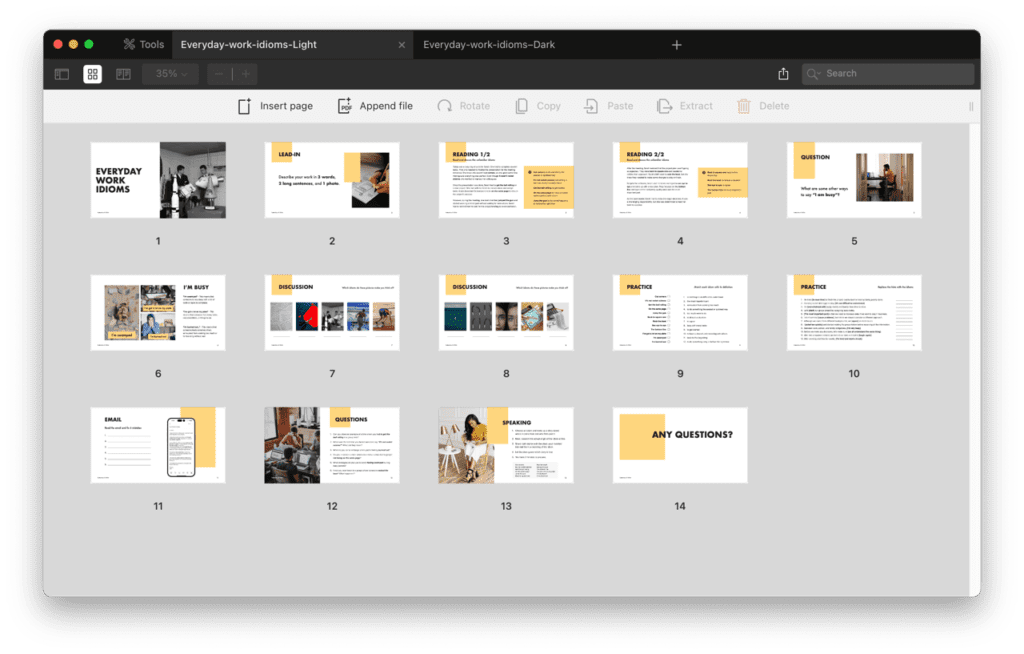
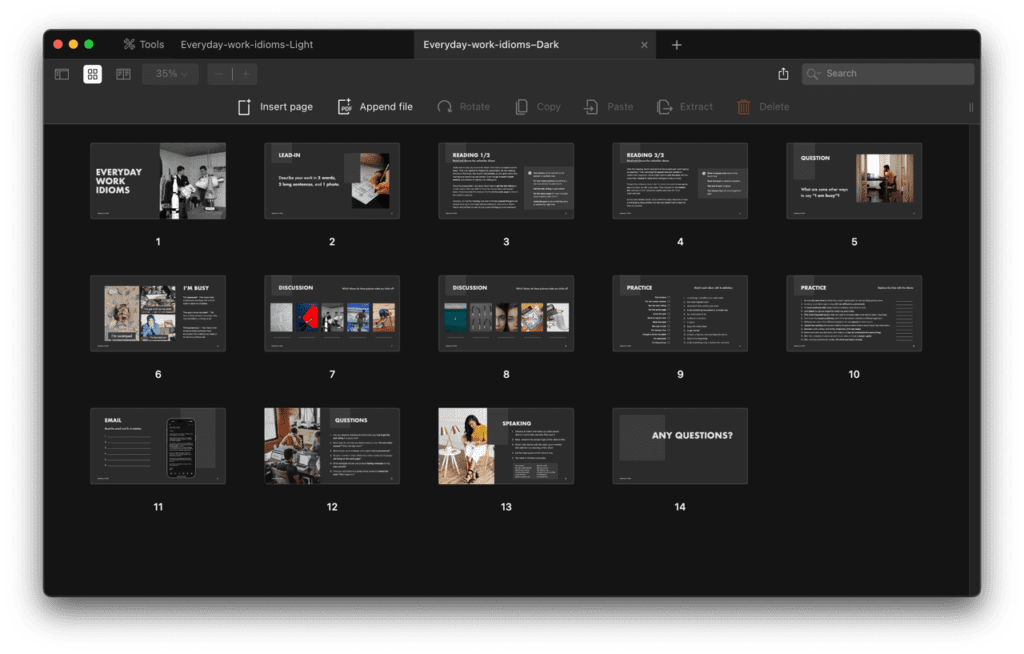
Start with the lead-in on page 2 where students describe their work using exactly three words, two long sentences, and one photo. This constrained format encourages precision. Students can show photos from their phones or describe imaginary ones.
Pages 3-4 present a story about Sarah’s workday that introduces all twelve target idioms in context. Read the first paragraph together, pausing to check comprehension of the idioms in the margin. Don’t over-explain. Just make sure students can follow the story. Continue with the second paragraph the same way.
Pages 5-6 focus on expressions for being busy. Students often overuse “I’m busy,” so these alternatives add variety. “I’m swamped” suggests temporary overload, “I’ve got a lot on my plate” emphasizes multiple responsibilities, and “I’m burned out” indicates exhaustion from sustained pressure.
Pages 7-8 use images to prompt idiom recall. Students look at each picture and identify which idiom it suggests. Scissors cutting paper might suggest “cut corners,” while a starting line might suggest “get the ball rolling.” Do these as whole-class activities where students call out suggestions and explain their thinking.
Page 9 has matching where students connect idioms with definitions. Page 10 asks students to replace hints in sentences with appropriate idioms, which is more challenging because they must identify the right idiom from context.
The email activity on page 11 shows how idioms function in workplace communication. Students read an email where six idioms are used incorrectly, then identify errors and write corrections.
Page 12 provides discussion questions that personalize the idioms. Each question prompts students to share real experiences. Students discuss in pairs before sharing with the class.
The speaking task on page 13 has students choose one idiom, invent a fake origin story, then research the real etymology. They present both stories to the class, who votes on which is true. Give students time to research and craft their fictional tales.
