
Do You Sound Rude in English?

This B1 lesson helps students avoid sounding unintentionally rude in English by teaching polite communication strategies. Students learn about intonation patterns, direct versus indirect language, and how to use modal verbs and softeners to make requests sound friendlier. The lesson includes practical exercises where students transform blunt statements into polite requests.
Lesson overview
- Practice distinguishing between rude and polite language in everyday English communication
- Learn how intonation affects meaning and can change friendly words into rude ones
- Explore modal verbs and softening phrases that make requests more indirect
- Develop skills for navigating polite communication in different social situations
| Level | Vocabulary | Lesson Time |
| B1 / Intermediate | 16 words | 60 min |
Vocabulary
- Sorry
- Excuse me
- Could
- Would
- May
- Might
- Be able to
- Just
- Quite
- Slight
- Possibly
- A bit (of)
- I think
- I wonder
- Would you mind
- Assist
Contents
- Lead-in
- Sorting
- Reading (Intonation)
- Practice
- Reading (Direct / Indirect language)
- Reading (Modals and Softeners)
- Examples
- Practice 1
- Practice 2
- Practice 3
- Discussion (Pictures)
- Quote
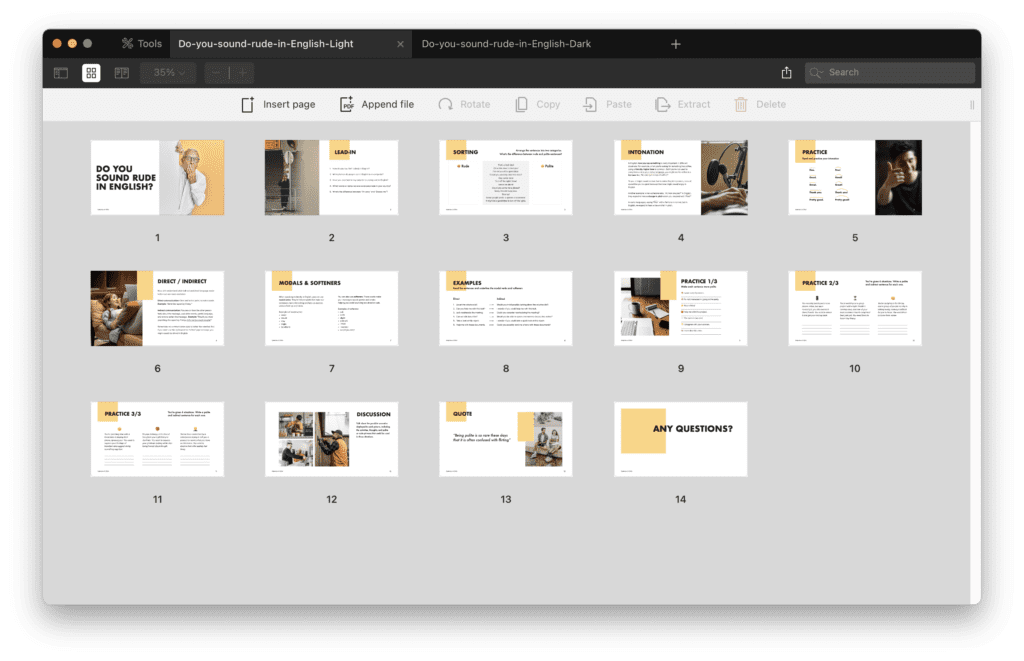
Start with the lead-in questions about politeness in English. Many students have experienced moments where they sounded ruder than they intended, so this topic hits home. The sorting activity on page 3 gives concrete examples of rude versus polite sentences. Have students work in pairs to categorize the sentences and discuss what makes each one rude or polite.
The intonation section on pages 4-5 addresses a common problem. Flat intonation can make perfectly polite words sound angry or unfriendly in English. Demonstrate the difference between saying “Fine” with flat intonation versus rising intonation. Have students practice the examples on page 5 with exaggerated intonation at first, then gradually make it more natural.
Page 6 introduces direct versus indirect communication styles. Emphasize that neither style is wrong, but English often prefers indirect phrasing in polite situations. The modal verbs and softeners on page 7 give students what they need. Go through the examples on page 8 together, having students underline the polite elements and notice how many words get added to soften the message.
Pages 9-11 move from simple to complex. Start with transformations on page 9 where students make direct sentences more polite. Then move to situational writing on pages 10-11 where students create complete polite responses to realistic scenarios like returning a broken phone or declining a sales call.
The discussion on page 12 uses workplace images to generate conversation. Students describe what might be happening and what polite phrases people might use. The quote on page 13 closes with humor while making a point about how politeness stands out in modern communication.
