
Different Ages & Stages of Life

This A2 lesson introduces vocabulary for describing different ages and life stages from birth through old age. Students learn to talk about age ranges, approximate ages, and discuss typical activities and experiences at various points in life.
Lesson overview
- Practice using vocabulary for age groups and life stages
- Learn expressions for approximating and describing ages accurately
- Develop speaking skills about life experiences at different ages
- Discuss cultural attitudes toward aging and generational differences
| Level | Vocabulary | Lesson Time |
| A2 / Pre-Intermediate | 17 words | 60 min |

Vocabulary
- Baby
- Toddler
- Preschooler
- Child/Kid
- Teenager
- Young Adult
- Middle-aged Adult
- Older Adult
- Elderly/Senior
- Early
- Mid
- Late
- Nearly
- Almost
- Give or take
Contents
- Lead-in
- Timeline
- Reading
- Discussion
- Reading
- Questions
- Vocabulary practice
- Speaking
- Quote
- Guess my age
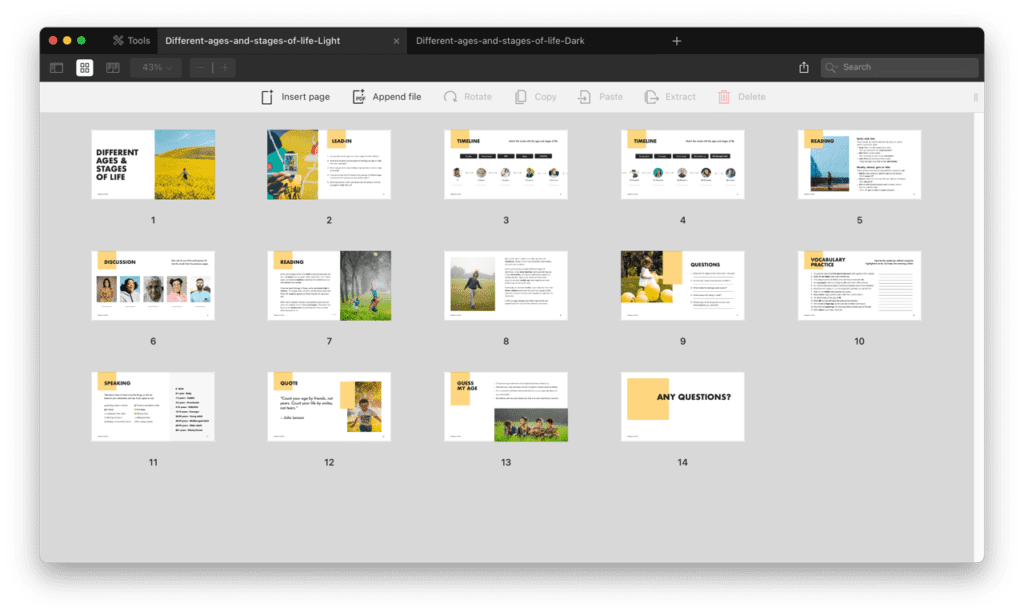
This A2 lesson covers vocabulary for describing ages and life stages from birth through old age. Students learn to talk about age ranges, approximate ages, and discuss typical experiences at various points in life.
Start with the lead-in questions on page 2 as a whole-class warm-up. Students share thoughts about aging, respect for different ages, and learning from other generations. Keep it brief and conversational.
Pages 3-4 present core vocabulary through timeline matching. Students match terms like “toddler,” “preschooler,” and “teenager” with age ranges. Check answers together and drill pronunciation, focusing on word stress. Ask which stage they’re in now and which they remember best.
Page 5 introduces language for being specific about ages. The “early/mid/late” structure is useful here. Practice with questions like “When did you start school?” or “When do people usually get married in your country?” This encourages phrases like “in my early twenties.” The approximation phrases (“nearly,” “almost,” “give or take”) help students sound more natural when estimating.
Page 6 has students estimate ages from photos using the new vocabulary. Push for complete sentences like “I think she’s in her late thirties” rather than just numbers.
The reading on pages 7-8 walks through life stages chronologically. The comprehension questions on page 9 work well in pairs before class discussion.
Page 10 offers vocabulary practice through sentence rewrites where students replace highlighted words with synonyms. Good controlled practice before freer speaking.
The speaking activity on page 11 generates discussion about appropriate ages for life milestones. Students debate when to get married, retire, travel. Expect disagreement based on cultural backgrounds.
Page 13 has a creative task where students describe a typical day at any age they choose, and classmates guess. Model this first by describing a day as a seven-year-old or sixty-year-old.
Finish with the John Lennon quote on page 12. Ask what students think it means about measuring life by quality rather than quantity.
