
Decoding the Meanings of Sh*t
This B2 upper-intermediate lesson examines the surprisingly versatile uses of a common English swear word through comedian Ismo’s hilarious stand-up routine. Students explore how context completely changes meaning, from “the shit” (amazing) to “piece of shit” (terrible). The lesson tackles informal language, cultural attitudes toward swearing, and the challenges non-native speakers face understanding slang. Through video analysis, vocabulary practice, and creative speaking activities, learners gain insight into authentic conversational English.
Lesson overview
- Analyze how one word transforms meaning based on articles and context
- Discuss cultural attitudes toward profanity in different situations
- Practice distinguishing between similar phrases with opposite meanings
- Develop comedic timing skills through a creative speaking performance
| Level | Vocabulary | Video Length | Lesson Time |
| B2 / Upper-Intermediate | 22 words | 3:54 min | 60-80 min |
Vocabulary
- shit / the shit
- give shit / give a shit
- take shit / take a shit
- don’t touch my shit
- have shit to do
- and shit
- piece of shit / giant piece of shit
- shoot
- bummer
- baloney
- nonsense
- BS
- crap
- shitload
- shitty
- shithole
- shitshow
- go apeshit
- no shit!
Contents
- Lead-in
- Situations
- Swearing in America
- Reading
- Video
- Questions
- Practice
- Vocabulary match
- Agree or disagree
- Extra words
- Speaking
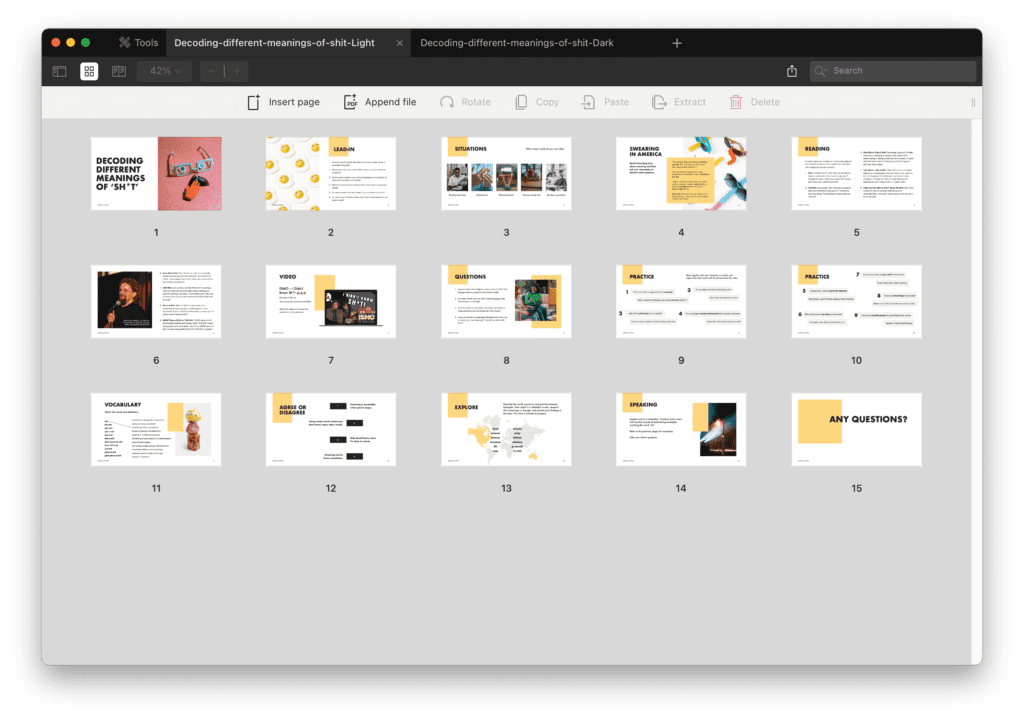
Start with the lead-in questions on page 2 about attitudes toward swearing. Set the tone early—this lesson looks at language objectively, not to encourage profanity but to understand how English actually works. Students usually have opinions here, so discussion comes easily. The situations activity on page 3 lets them share which expressions they actually use.
Page 4 has statistics about American swearing habits. Have students read these and come up with discussion questions. Framing it as data helps—swearing becomes something worth examining rather than just taboo. Before the video, work through the reading on pages 5-6 that summarizes Ismo’s routine. This makes the comedy easier to follow.
Play the video on page 7, pausing after each major point if needed. Ismo’s delivery tends to get laughs, which helps the vocabulary stick. The confusion he describes will feel familiar to anyone learning English. Use the discussion questions on page 8 to talk about how comedy exposes language weirdness. Students can share times they’ve misunderstood English expressions.
The practice dialogues on pages 9-10 let students use the phrases in context. Run these as substitution drills, swapping in the target expressions. The vocabulary matching on page 11 covers all the variations—have students complete it alone before checking answers.
The agree/disagree statements on page 12 return to bigger questions about profanity. The explore activity on page 13 introduces related slang—assign different words to small groups for research and short presentations. The final task on page 14 has students create their own comedy routine. Give them time to prepare and encourage them to have fun with it.
