
Common Phrases English Speakers Use Daily
This B1 lesson teaches students 10 everyday English phrases that native speakers use in daily conversations. Students learn expressions like “put it off,” “like clockwork,” and “go with the flow” through gap-fill exercises, matching activities, and speaking practice. The lesson includes a TikTok video analysis, error correction, and a creative Mad Lib story game.
Lesson overview
- Learn 10 common conversational phrases used by native English speakers daily
- Practice using everyday expressions through gap-fill and matching definition activities
- Master error correction skills by finding and fixing mistakes in sentences
- Create funny Mad Lib stories using the new phrases and vocabulary
| Level | Vocabulary | Lesson Time |
| B1 / Intermediate | 10 phrases | 60 min |
Vocabulary
- Put it off
- It’s a hassle
- Like clockwork
- Get into habit
- Slowly but surely
- That being said
- As it turns out
- Go with the flow
- Now that I think about it
- At the end of the day
Contents
- Lead-in 1
- Lead-in 2
- Daily phrases 1
- Daily phrases 1
- Daily phrases 1
- Matching
- Speaking
- Mistakes
- Quote
- Short video
- Madlib
- Extra task
- Homework
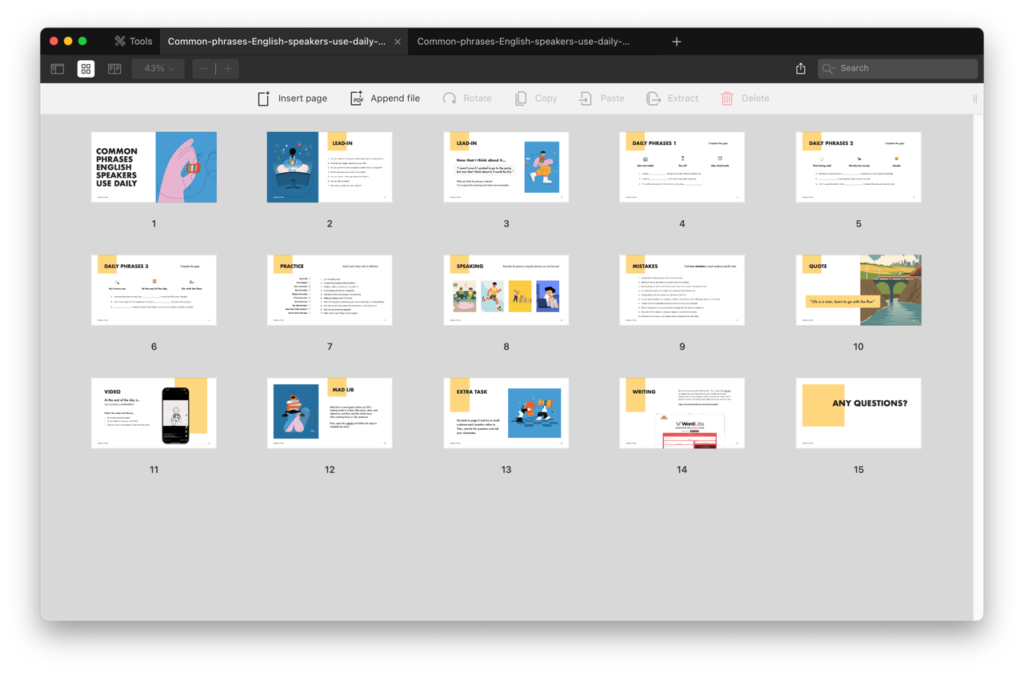
Start with the lead-in questions on page 2. These seven questions connect to the phrases students will learn later. After discussion, move to page 3 for “now that I think about it.” Let students guess the meaning from the example sentence.
Pages 4-6 introduce the 10 phrases in three groups with gap-fill practice. Go through each group, explain the meanings, and have students complete the sentences. The emojis give hints about which phrase goes where. After all three pages, do the matching activity on page 7 where students connect each phrase to its definition.
Page 8 has picture descriptions. Pair up students to describe what’s happening using the new phrases. Page 9 is error correction with two mistakes per sentence. Students hunt for spelling and grammar errors while reviewing the phrases. Pairs work better here than solo.
The TikTok video on page 11 shows a joke about “at the end of the day.” Play it twice and discuss the three questions. Half the class usually misses the pun on the first watch. Pages 12-13 introduce Mad Libs, where students fill in random words to create silly stories. Demo one together first or you’ll spend 10 minutes answering questions. The writing task on page 14 has students create their own Mad Lib using the website. Page 13 circles back to page 2 where students match phrases to the original lead-in questions.
