
Best & Worst Jobs in Today’s Market

This B2 level lesson helps upper-intermediate students explore career choices and job market realities. Students examine what makes certain professions desirable or challenging while building vocabulary related to employment and workplace conditions. The lesson combines real labor market data with practical speaking activities to develop career-related communication skills.
Lesson overview
- Practice discussing career aspirations and workplace preferences authentically
- Learn vocabulary for describing job conditions and compensation structures
- Explore current employment trends through real market data
- Develop interview skills through role-play scenarios
| Level | Vocabulary | Lesson Time |
| B2 / Upper-Intermediate | 12 words | 60 min |
Vocabulary
- Highly sought after
- Competitive salary
- Growth potential
- Sense of fulfillment
- Lucrative career
- Collaboration
- High demand
- Coordinate
- Routine task
- Advancement opportunity
- Compensation
- Irregular hours
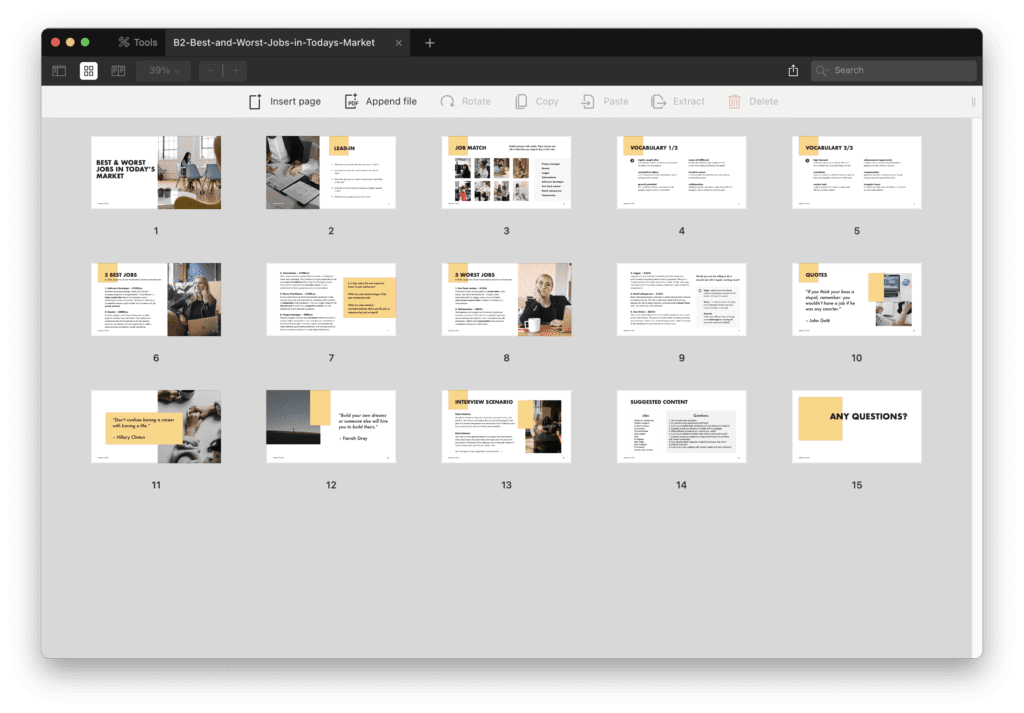
Contents
- Lead-in
- Job match
- Vocabulary
- 5 best jobs and follow-up questions
- 5 worst jobs and follow-up questions
- Quotes
- Interview scenario
Start with the warm-up questions on page 2 to get students thinking about careers. Give them three minutes in pairs to chat about what jobs they dreamed about as kids and what professions seem brutal. This gets the conversation going before you throw new vocabulary at them.
Move to the job-matching thing on page 3. Students match eight profession pictures with the job names, then describe what a typical day looks like in one of those roles. This previews the main professions you’ll talk about and gives them practice with present simple for daily routines. Walk around and make note of any vocabulary they’re missing so you can circle back later.
Teach the vocab on pages 4-5 before they read anything. Hit the collocations hard, stuff like “competitive salary” and “advancement opportunity,” since B2 students really need these for workplace conversations. Use concept checking questions like “Does high demand mean lots of people want it or barely anyone wants it?” to make sure they get it.
For the reading on pages 6-9, try jigsaw reading. Split the class so half reads about the best jobs and the other half reads about the worst ones. Then partners share what they learned and talk through the follow-up questions. This creates a real reason to communicate instead of just going through the motions. The wage versus salary explanation on page 9 usually confuses people, so have a timeline ready showing how each payment type plays out over a month.
The quotes on pages 10-12 work great as discussion starters or writing prompts. Students can say whether they agree or disagree with each one and back it up with their own examples. This flows nicely into the interview role-play on pages 13-14, where one student interviews another for a mystery job. The interviewer picks from the suggested jobs and questions while the other person responds naturally, then tries to guess what position it was for. Wrap up by talking about what the interview answers showed about what the job needs.
