
Abandoning the Digital Nomad Lifestyle

This C1-level lesson examines why some remote workers abandon the digital nomad lifestyle after experiencing its challenges. Advanced students analyze an authentic BBC article, explore complex vocabulary about remote work, and debate the realities behind the romanticized image of location-independent careers.
Lesson overview
- Analyze authentic journalism about digital nomadism’s downsides
- Master advanced vocabulary like repercussions, untethered, and daunting
- Evaluate controversial statements about remote work culture
- Develop extended speaking skills through persuasive role-plays
| Level | Vocabulary | Reading Time | Lesson Time |
| C1 / Advanced | 18 words | 7 min / 1281 words | 60-80 min |
Vocabulary
- Conjure
- Picturesque
- Ad-hoc income
- Untethered
- Take a toll
- Ebb
- Repercussions
- Daunting
- Taken aback
- Surge
- Workation
- Sabbatical
- Bleisure
- Flexcation
- Jobbymoon
- Gap year
- Career break
- Remote Year
Contents
- Lead-in
- Agree or disagree
- Vocabulary
- Article reading
- Skimming
- Vocabulary practice 1
- Vocabulary practice 2
- Vocabulary practice 3
- Explore
- Speaking
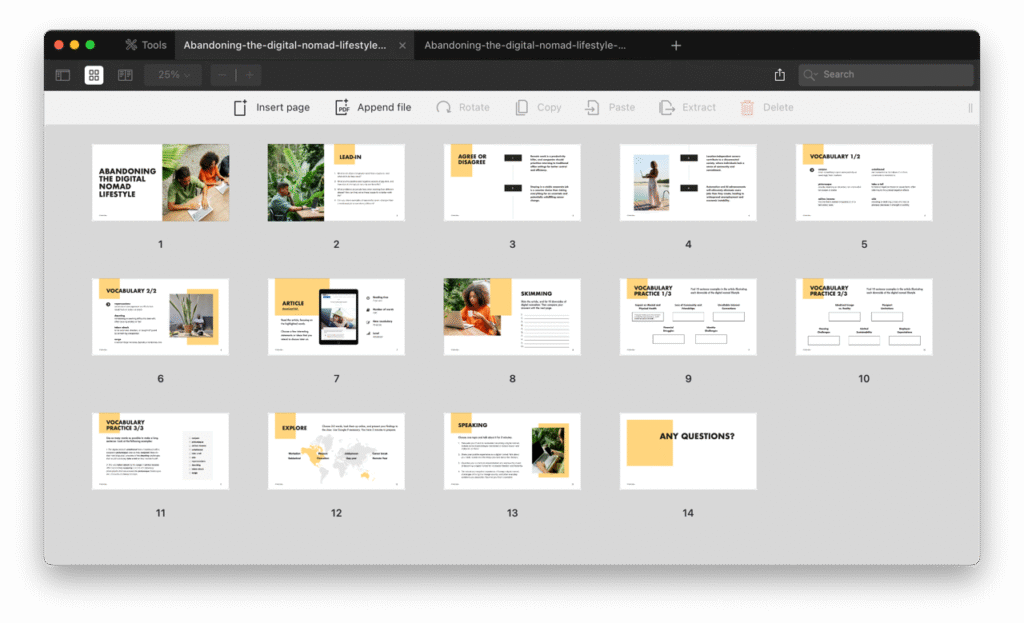
Start with the lead-in questions on page 2 about remote work and career flexibility. This 10-minute discussion taps into what students already know and sets up the lesson. Pages 3-4 have provocative statements about remote work for debate. Have students pick sides and back up their views with examples. This critical thinking warm-up gets them ready for the nuanced article coming up.
Go over the vocab on pages 5-6 before reading. Students need to know terms like conjure, picturesque, and repercussions since these pop up throughout the text. The article on page 7 needs about 7 minutes of silent reading. Students should highlight interesting stuff to discuss later. This authentic BBC text challenges C1 readers with complex sentence structures and sophisticated vocab in context.
The skimming activity on page 8 checks comprehension by asking students to list ten downsides of digital nomadism from the article. Give them 5 minutes to scan, then compare answers as a class. Pages 9-10 have students find specific sentences that show each challenge. This close reading reinforces comprehension while building their ability to pull evidence from complex texts.
Page 11 has an advanced vocab challenge where students create long sentences using multiple target words. Show them the examples provided, then give pairs 5 minutes to come up with their own complex sentences. This synthesis activity shows whether they really own the new vocab. The exploration task on page 12 introduces related terms like workation and bleisure. Students look these up online and present what they find, which builds independent learning skills.
Wrap up with the extended speaking activity on page 13. Students pick one role-play scenario and speak for 3 minutes on topics like talking someone out of digital nomadism or describing bad experiences abroad. This develops fluency, argumentation, and the ability to keep a complex conversation going at an advanced level.
