
5 Reasons Why You Shouldn’t Ride A Motorcycle

This B2 lesson explores motorcycle safety through listening, vocabulary, and debate activities. Students learn motorcycle vocabulary and terms like acknowledge, coordination, and fatality while listening to an experienced rider explain dangers of motorcycling. The lesson combines listening comprehension with safety discussions and opinion-sharing about transportation choices.
Lesson overview
- Learn motorcycle vocabulary and safety-related terms for B2 level discussions
- Practice listening comprehension with authentic audio from experienced motorcycle trainer
- Develop debate skills through agree/disagree statements about motorcycle riding safety
- Build confidence discussing transportation choices and recognizing risks in daily decisions
| Level | Vocabulary | Listening Time | Lesson Time |
| B2 / Upper-Intermediate | 10 words | 3 min | 60-90 min |
Vocabulary
- acknowledge
- ignore
- gear
- tremendous amount
- coordination
- lifelong education
- discipline
- maturity
- recognize
- fatality
Contents
- Lead-in
- Motorcycle vocabulary
- Vocabulary preview
- Vocabulary
- Listening intro
- Audio 1 – Fill in the blanks
- Audio 2 – Prediction
- Audio 3 – True or false
- Audio 4 – Shadowing
- Audio 5 – Summarizing with keywords
- Agree / Disagree
- Vocabulary practice
- Group discussion
- Voice recording
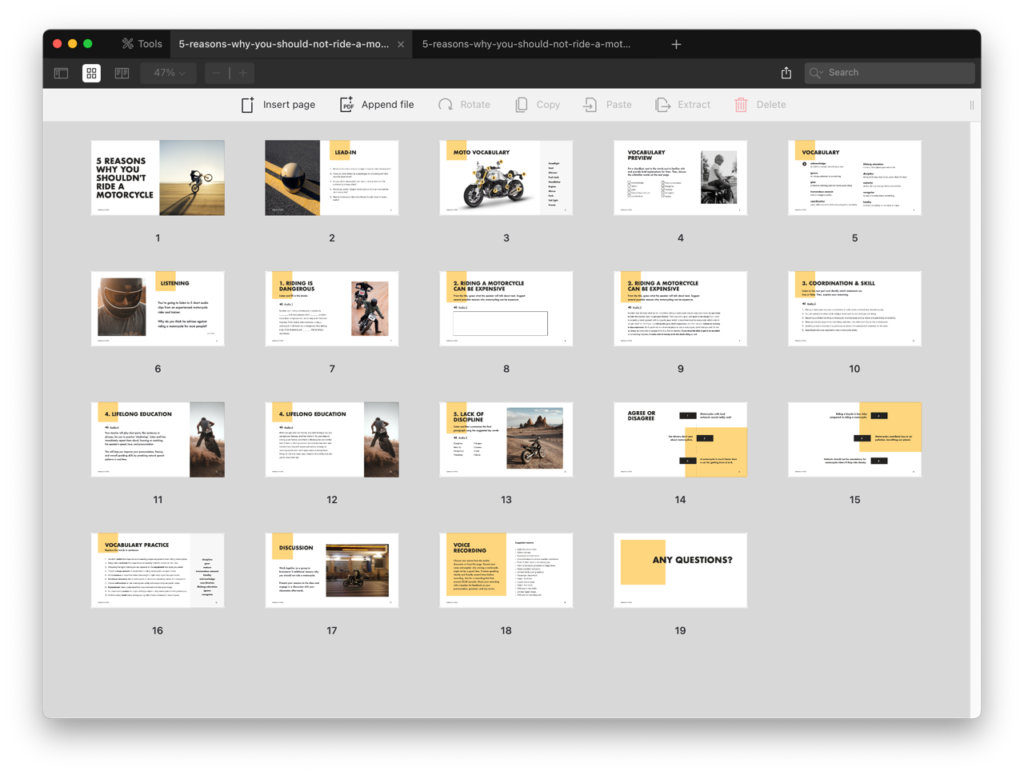
Start with lead-in questions about motorcycle riding and have students label motorcycle parts. This vocabulary activity takes five minutes but you can’t skip it because terms like handlebar, silencer, and fork show up throughout the lesson. Pre-teach the main vocabulary (acknowledge, gear, coordination, maturity, fatality) before the listening. These words are more abstract than the motorcycle parts, so give real examples to check understanding.
Play the five audio clips from the motorcycle trainer. Each clip covers one reason not to ride: danger, expense, coordination, lifelong education, lack of discipline. The first audio does fill-in-the-blanks. The second has students predict before listening. The third uses true/false. The fourth does shadowing where students repeat phrases right after hearing them. The fifth asks for summarizing with key words. Mixing up the activity types keeps B2 students from zoning out after audio three.
The agree/disagree activity has six motorcycle statements. Students pick sides on loud exhausts, mandatory helmets, and environmental impact. These debates actually work because the statements are provocative enough that students genuinely disagree. The vocabulary practice has students replace words in sentences, which shows whether they learned the meanings or just guessed during the audio.
Wrap up with group brainstorming of three more reasons against motorcycles, then the voice recording. Students pick one reason, practice out loud, and record 30-40 seconds. This recording assignment is better than in-class presentations because students can redo it until they’re happy with it, and you get to hear everyone’s actual speaking level without time pressure. The suggested reasons list saves students who freeze when asked to generate ideas on their own.
